Advertisements
Advertisements
Question
In \(\triangle \mathrm{ABC}, \mathrm{AD}\) is the bisector of \(\angle \mathrm{A}\).
If \(\mathrm{BC} = 10 \mathrm{~cm}, \mathrm{BD} = 6 \mathrm{~cm}\) and \(\mathrm{AC} = 6 \mathrm{~cm}\), find AB.
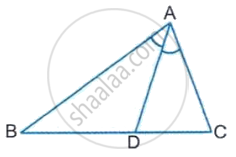
[\[\textbf{Hint.} \frac{BD}{DC} = \frac{AB}{AC}.\]]
Advertisements
Solution
Given $$\mathrm{BC} = 10\text{ cm}$$ and $$\mathrm{BD} = 6\text{ cm}$$.
$$\mathrm{DC} = \mathrm{BC} - \mathrm{BD}$$
$$= 10 - 6$$
$$= 4\text{ cm}$$
By the Angle Bisector Theorem, the bisector of an interior angle of a triangle divides the opposite side internally in the ratio of the sides containing the angle: $$\frac{\mathrm{BD}}{\mathrm{DC}} = \frac{\mathrm{AB}}{\mathrm{AC}}$$
Substitute the given values:
$$\frac{6}{4} = \frac{\mathrm{AB}}{6}$$
$$\mathrm{AB} = \frac{6 \times 6}{4}$$
$$= \frac{36}{4}$$
$$= 9\text{ cm}$$
