Advertisements
Advertisements
Question
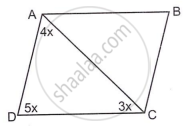
In the parallelogram ABCD, ∠D = 5x, ∠DAC = 4x and ∠ACD = 3x. Find the angles of ΔABC.
Advertisements
Solution
Calculation of x
The sum of angles in ΔACD is 180°.
Therefore, ∠D + ∠DAC + ∠ACD = 180°.
Substituting the given values, 5x + 4x + 3x = 180°.
Combining like terms, 12x = 180°.
Solving for x, x = `180^circ/12` = 15°.
Determination of Angles in Parallelogram ABCD
∠D = 5x = 5 × 15° = 75°.
In a parallelogram, opposite angles are equal, so ∠B = ∠D = 75°.
Adjacent angles in a parallelogram are supplementary, so A + ∠D = 180°.
Therefore, ∠A = 180° – 75° = 105°.
Similarly, ∠C = ∠A = 105°.
Calculation of Angles in ΔABC
∠B of ΔABC is ∠ABC, which is 75°.
Since AD || BC in a parallelogram, ∠DAC and ∠ACB are alternate interior angles.
Therefore, ∠ACB = ∠DAC = 4x = 4 × 15° = 60°.
The sum of angles in ΔABC is 180°. Therefore, ∠BAC + ∠ABC + ∠ACB = 180°.
Substituting the known values, ∠BAC + 75° + 60° = 180°.
Simplifying, ∠BAC + 135° = 180°.
Solving for ∠BAC, ∠BAC = 180° – 135° = 45°.
