Advertisements
Advertisements
Question
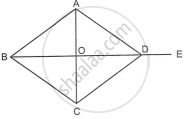
In a rhombus ABCD, the diagonals AC and BD intersect at O. BD is produced to E. ∠ADO : ∠ADE = 1 : 4. Find the angles of ΔAOB.
Advertisements
Solution
Given:
- Rhombus ABCD with diagonals AC and BD that intersect at O.
- The ratio of the angles ∠ADO to ∠ADE is 1 : 4.
Step-by-step:
Angle Relationship:
In a rhombus, the diagonals bisect each other at right angles, meaning ∠AOB = 90°.
Angle Proportions:
Since ∠ADO and ∠ADE are in the ratio of 1 : 4, let the smaller angle ∠ADO be x and the larger angle ∠ADE be 4x.
Using the Total Angle at D:
The sum of angles at point D must be 180° (since they are on a straight line).
Therefore, ∠ADO + ∠ADE = 180°.
Substituting the ratio:
x + 4x = 180°
5x = 180°
x = 36°
Calculating the Angles:
So, ∠ADO = 36° and ∠ADE = 144°.
Triangle AOB:
Since the diagonals intersect at right angles, ∠AOB = 90°.
Final Angles:
In triangle AOB:
∠AOB = 90°
∠OAB = 36°
∠OBA = 54° (since the angles of a triangle sum up to 180° and 180° – 90° – 36° = 54°).
Thus, the angles of triangle AOB are 36°, 54° and 90°.
