Advertisements
Advertisements
Question
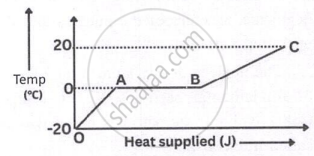
In the graph, a given quantity of ice is converted to water.
- What does the portion AB represent?
- Why is the portion AB parallel to the time axis?
- Why is the slope OA steeper than the slope BC?
Very Long Answer
Advertisements
Solution
- The portion AB represents the change of state of ice to water, i.e., melting or fusion, taking place at a constant temperature of 0°C. During this stage, ice absorbs heat without any rise in temperature.
- The portion AB is parallel to the time axis because the heat supplied to the ice is used as latent heat of fusion. This heat is consumed in overcoming the intermolecular forces and changing ice into water, not in increasing the kinetic energy of the molecules. Therefore, the temperature remains constant at 0°C, and the graph becomes a horizontal line.
- The slope OA is steeper than the slope BC because the specific heat capacity of ice is less than that of water. For the same amount of heat supplied per unit time, ice shows a greater rise in temperature than water. Hence, the temperature-time graph rises more steeply for ice (OA) than for water (BC).
shaalaa.com
Is there an error in this question or solution?
