Advertisements
Advertisements
Question
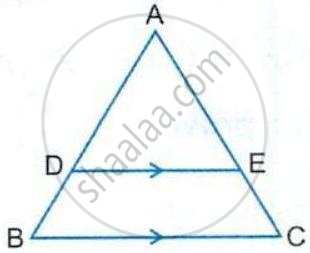
In the given figure, \(\mathrm{DE} \parallel \mathrm{BC}\).
- If \(\mathrm{AD}=3 \cdot 6 \mathrm{~cm}, \mathrm{AB}=9 \mathrm{~cm}\) and \(\mathrm{AE}=2 \cdot 4 \mathrm{~cm}\), find EC.
- If \(\frac{\mathrm{AD}}{\mathrm{DB}}=\frac{3}{5}\) and \(\mathrm{AC}=5 \cdot 6 \mathrm{~cm}\), find AE.
- If \(\mathrm{AD}=x \mathrm{~cm}, \mathrm{DB}=(x-2) \mathrm{~cm}, \mathrm{AE}=(x+2) \mathrm{~cm}\) and \(\mathrm{EC}=(x-1) \mathrm{~cm}\), find the value of x.
Advertisements
Solution
In $$\triangle \mathrm{ABC}$$, since $$\mathrm{DE} \parallel \mathrm{BC}$$, by the Basic Proportionality Theorem: $$\frac{\mathrm{AD}}{\mathrm{DB}} = \frac{\mathrm{AE}}{\mathrm{EC}}$$
i. Given $$\mathrm{AD} = 3.6\text{ cm}$$, $$\mathrm{AB} = 9\text{ cm}$$ and $$\mathrm{AE} = 2.4\text{ cm}$$.
$$\mathrm{DB} = \mathrm{AB} - \mathrm{AD}$$
$$= 9 - 3.6$$
$$= 5.4\text{ cm}$$
Using the theorem: $$\frac{3.6}{5.4} = \frac{2.4}{\mathrm{EC}}$$
$$\frac{2}{3} = \frac{2.4}{\mathrm{EC}}$$
$$\mathrm{EC} = \frac{2.4 \times 3}{2} = 3.6\text{ cm}$$
ii. Given $$\frac{\mathrm{AD}}{\mathrm{DB}} = \frac{3}{5}$$ and $$\mathrm{AC} = 5.6\text{ cm}$$.
By the Basic Proportionality Theorem: $$\frac{\mathrm{AE}}{\mathrm{EC}} = \frac{\mathrm{AD}}{\mathrm{DB}} = \frac{3}{5}$$
Let $$\mathrm{AE} = y\text{ cm}$$.
Then $$\mathrm{EC} = (5.6 - y)\text{ cm}$$.
$$\frac{y}{5.6 - y} = \frac{3}{5}$$
$$5y = 3(5.6 - y)$$
$$5y = 16.8 - 3y$$
$$8y = 16.8$$
$$y = 2.1\text{ cm}$$
Therefore, $$\mathrm{AE} = 2.1\text{ cm}$$.
iii. Given $$\mathrm{AD} = x\text{ cm}$$, $$\mathrm{DB} = (x - 2)\text{ cm}$$, $$\mathrm{AE} = (x + 2)\text{ cm}$$ and $$\mathrm{EC} = (x - 1)\text{ cm}$$.
$$\frac{x}{x - 2} = \frac{x + 2}{x - 1}$$
Cross-multiplying: $$x(x - 1) = (x + 2)(x - 2)$$
$$x^2 - x = x^2 - 4$$
$$-x = -4$$
$$x = 4$$
