In the given figure, $$\mathrm{BC} \parallel \mathrm{DE}$$, area $$(\triangle \mathrm{ABC}) = 25 \mathrm{~cm}^{2}$$, area (trap. BCED)$$ = 24 \mathrm{~cm}^{2}$$ and $$\mathrm{DE} = 14 \mathrm{~cm}$$.
Advertisements
Question
In the given figure, $$\mathrm{BC} \parallel \mathrm{DE}$$, area $$(\triangle \mathrm{ABC}) = 25 \mathrm{~cm}^{2}$$, area (trap. BCED)$$ = 24 \mathrm{~cm}^{2}$$ and $$\mathrm{DE} = 14 \mathrm{~cm}$$. Calculate the length of BC.
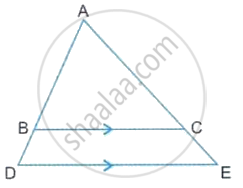
[Hint: \[\mathit{Area}\ (\triangle\ ADE) = \mathit{Area}\ (\triangle\ ABC) + \mathit{Area}\ (\mathit{trap.}\ BDEC) = 49\ cm^{2}.\]
\[\triangle ABC \sim \triangle ADE \Rightarrow \frac{\mathit{Area}(\triangle ABC)}{\mathit{Area}(\triangle ADE)} = \frac{BC^{2}}{DE^{2}}.\]]
Advertisements
Solution
$$\operatorname{ar}(\triangle \mathrm{ADE}) = \operatorname{ar}(\triangle \mathrm{ABC}) + \operatorname{ar}(\operatorname{trap. BCED})$$
$$= 25\text{ cm}^2 + 24\text{ cm}^2$$
$$= 49\text{ cm}^2$$
In $$\triangle \mathrm{ABC}$$ and $$\triangle \mathrm{ADE}$$:
$$\angle \mathrm{ABC} = \angle \mathrm{ADE}$$ (Corresponding angles, since $$\mathrm{BC} \parallel \mathrm{DE}$$)
$$\angle \mathrm{BAC} = \angle \mathrm{DAE}$$ (Common angle)
Therefore, by AA-similarity criterion: $$\triangle \mathrm{ABC} \sim \triangle \mathrm{ADE}$$.
The areas of similar triangles are proportional to the squares of their corresponding sides:
$$\frac{\operatorname{ar}(\triangle \mathrm{ABC})}{\operatorname{ar}(\triangle \mathrm{ADE})} = \frac{\mathrm{BC}^2}{\mathrm{DE}^2}$$
$$\Rightarrow \frac{25}{49} = \frac{\mathrm{BC}^2}{14^2}$$
Taking square roots on both sides:
$$\frac{5}{7} = \frac{\mathrm{BC}}{14}$$
$$\Rightarrow \mathrm{BC} = \frac{5 \times 14}{7} = 10\text{ cm}$$
Hence, the length of $$\mathrm{BC}$$ is $$10\text{ cm}$$.
