Advertisements
Advertisements
Question
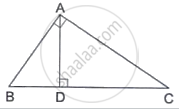
In the given figure, ∠BAC = 90° and AD ⊥ BC. Then,
Options
BC · CD = BC2
AB · AC = BC2
BD · CD = AD2
AB · AC = AD2
Advertisements
Solution
BD · CD = AD2
Explanation:
1. Identifying similar triangles
In ΔABC, we are given that ∠BAC = 90° and AD ⊥ BC.
Let ∠BCA = θ.
In the right-angled ΔABC:
∠ABC = 90° – θ
In the right-angled ΔADC (where ∠ADC = 90°):
∠DAC = 90° – θ
In the right-angled ΔADB (where ∠ADB = 90°):
∠BAD = 90° – (90° – θ) = θ
By comparing the angles of ΔDBA and ΔDAC, we have:
1. ∠ADB = ∠ADC = 90°
2. ∠ABD = ∠DAC = 90° – θ
3. ∠BAD = ∠ACD = θ
By AA (Angle-Angle) similarity criterion, the two smaller triangles are similar to each other:
ΔDBA ∼ ΔDAC
2. Setting up the ratio
Since corresponding sides of similar triangles are in the same proportion, we can relate their sides:
`(BD)/(AD) = (AD)/(CD)`
3. Deriving the final relationship
By cross-multiplying the proportional side lengths from the previous step:
BD · CD = AD · AD
BD · CD = AD2
