Advertisements
Advertisements
Question
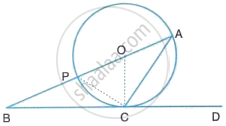
In the following figure, O is the centre of the circle and BCD is tangent to it at C. Prove that ∠BAC + ∠ACD = 90°.
Advertisements
Solution
Given:
O is the centre of the circle.
The line B–C–D is tangent to the circle at C.
A, O and the point opposite A on the circle are collinear (so AO is along a diameter / BA is the diameter produced) — as shown in the figure.
To Prove: ∠BAC + ∠ACD = 90°.
Proof [Step-wise]:
1. OA and OC are radii of the circle, so OA = OC.
Hence triangle AOC is isosceles and its base angles are equal: ∠OAC = ∠ACO.
2. The radius drawn to the point of contact is perpendicular to the tangent.
Since BCD is tangent at C, OC ⟂ CD.
3. Because OC ⟂ CD, the angle made at C by AC and the tangent CD is complementary to the angle between AC and OC. In other words, ∠ACO + ∠ACD = 90°. (OC and CD form a right angle, so the two angles from AC to OC and from AC to CD add to 90°.)
4. From (1) we have ∠OAC = ∠ACO.
From the figure (A, O, B are collinear), ∠BAC = ∠OAC.
Therefore ∠BAC = ∠ACO.
5. Replace ∠ACO in step (3) by ∠BAC (using step 4): ∠BAC + ∠ACD = 90°.
Thus ∠BAC + ∠ACD = 90°, as required.
