Advertisements
Advertisements
Question
In the following figure, AD ⊥ BC and AD is the bisector of angle BAC. Then, ∆ABD ≅ ∆ACD by RHS.

Options
True
False
Advertisements
Solution
This statement is False.
Explanation:
In ∆ABD and ∆ACD,
AD = AD ...[Common]
∠BAD = ∠CAD ...[∵ AD is the bisector of ∠BAC]
∠ADB = ∠ADC ...[Each 90°, ∵ AD ⊥ BC]
∴ ∆ABD ≅ ∆ACD ...[By ASA criterion]
APPEARS IN
RELATED QUESTIONS
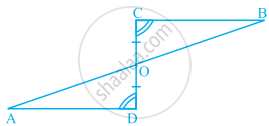
In Fig, can you use the ASA congruence rule and conclude that ∆AOC ≅ ∆BOD?
In the given figure, AC ≡ AD and ∠CBD ≡ ∠DEC. Prove that ∆BCF ≡ ∆EDF.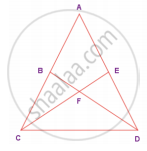
To conclude the congruency of triangles, mark the required information in the following figure with reference to the given congruency criterion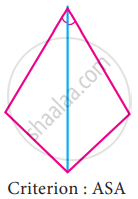
For the given pair of triangles state the criterion that can be used to determine the congruency?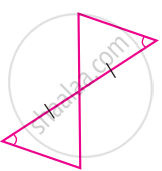
For the given pair of triangles state the criterion that can be used to determine the congruency?
In the given figure, AD = CD and AB = CB. Identify the other three pairs that are equal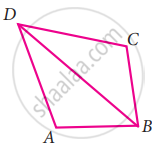
In the given figure ray AZ bisects ∠BAD and ∠DCB, prove that ∆BAC ≅ ∆DAC
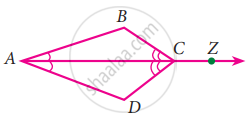
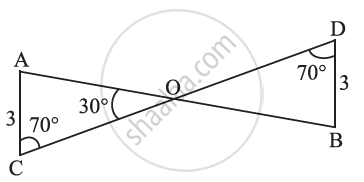
In the given pairs of triangles of figure, applying only ASA congruence criterion, determine which triangles are congruent. Also, write the congruent triangles in symbolic form.
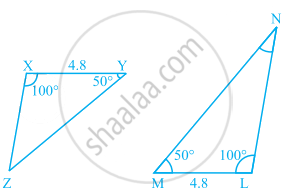
In the given pairs of triangles of figure, applying only ASA congruence criterion, determine which triangles are congruent. Also, write the congruent triangles in symbolic form.

In the given pairs of triangles of figure, applying only ASA congruence criterion, determine which triangles are congruent. Also, write the congruent triangles in symbolic form.