Advertisements
Advertisements
Question
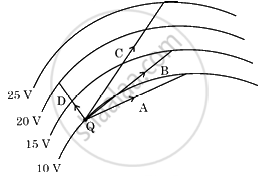
In the figure curved lines represent equipotential surfaces. A charge Q is moved along different paths A, B, C and D. The work done on the charge will be maximum along the path:
Options
A
B
C
D
MCQ
Advertisements
Solution
C
Explanation:
Work done = ΔV × Q
Work done does not depend on the path travelled because the electric field is a conservative field.
W(A) = (10 − 10) × Q
= 0
W(B) = (15 − 10) × Q
= 5 Q
W(C) = (25 − 10) × Q
= 15 Q
W(D) = (20 − 10) × Q
= 10 Q
Thus, maximum work is in C.
shaalaa.com
Is there an error in this question or solution?
