Advertisements
Advertisements
Question
In the combinations of resistors shown below, calculate:
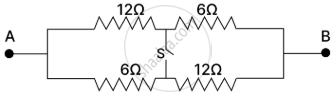
- the resistance across AB when the switch S is open.
- the resistance across AB when the switch S is closed.
Advertisements
Solution
a. When the switch is open, the middle connection does not join the two branches. So the circuit has two separate branches in parallel, i.e., top and bottom branches, where 12 Ω and 6 Ω resistances are in series.
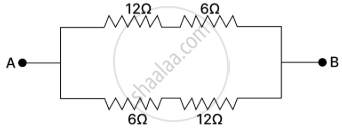
Then the net resistance of the top branch is given by,
R1 = 12 + 6
= 18 Ω
Now, R1 and R2 are in parallel connection, and the net resistance is given by,
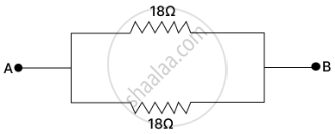
`1/R = 1/R_1 + 1/R_2`
= `1/18 + 1/18`
= `2/18`
⇒ `1/R = 1/9`
R = 9 Ω
Hence, the resistance across AB when the switch S is open is 9 Ω.
b. When switch S is closed, the midpoints are connected, which rearranges the circuit into two branches of parallel resistors that are connected in series as shown below.
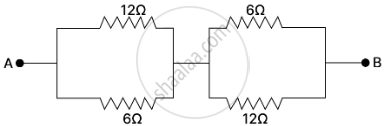
Then the net resistance of the left branch (containing 12 Ω and 6 Ω resistances) is given by,
`1/R_1 = 1/12 + 1/6`
= `1/12 + 2/12`
= `3/12`
⇒ `1/R_1 = 1/4`
⇒ R1 = 4 Ω
Similarly, the net resistance of the right branch (containing 12 Ω and 6 Ω resistances) is given by,
`1/R_2 = 1/12 + 1/6`
= `1/12 + 2/12`
= `3/12`
⇒ `1/R_2 = 1/4`
⇒ R2 = 4 Ω
Now, R1 and R2 are in series connection, and the net resistance is given by,

R = R1 + R2
= 4 + 4
= 8 Ω
Hence, the resistance across AB when the switch S is closed is 8 Ω.
