In the adjoining figure, PQRS is a parallelogram with $$\mathrm{PQ} = 15 \mathrm{~cm}$$ and $$\mathrm{RQ} = 10 \mathrm{~cm}$$. If L is a point on RP such that $$\mathrm{RL} : \mathrm{PL} = 2 : 3$$
Advertisements
Question
In the adjoining figure, PQRS is a parallelogram with $$\mathrm{PQ} = 15 \mathrm{~cm}$$ and $$\mathrm{RQ} = 10 \mathrm{~cm}$$. If L is a point on RP such that $$\mathrm{RL} : \mathrm{PL} = 2 : 3$$ and QL produced meets RS at M and PS produced at N. Find the lengths of PN and RM.
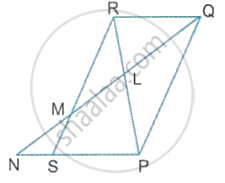
[Hint: \[\triangle RLQ \sim \triangle PLN \Rightarrow \frac{RL}{PL} = \frac{RQ}{PN}.\]
\[\triangle \mathrm{RLM} \sim \triangle \mathrm{PLQ} \Rightarrow \frac{RL}{PL} = \frac{RM}{PQ}.\]]
Advertisements
Solution
In parallelogram $$\mathrm{PQRS}$$, opposite sides are equal and parallel:
$$\mathrm{PS} = \mathrm{RQ} = 10\text{ cm}$$ and $$\mathrm{RS} = \mathrm{PQ} = 15\text{ cm}$$
To find $$\mathrm{PN}$$: Since $$\mathrm{PN} \parallel \mathrm{RQ}$$, in $$\triangle \mathrm{RLQ}$$ and $$\triangle \mathrm{PLN}$$:
$$\angle \mathrm{RLQ} = \angle \mathrm{PLN}$$ (Vertically opposite angles)
$$\angle \mathrm{LRQ} = \angle \mathrm{LPN}$$ (Alternate interior angles)
Therefore, $$\triangle \mathrm{RLQ} \sim \triangle \mathrm{PLN}$$ (by AA-similarity).
$$\Rightarrow \frac{\mathrm{RL}}{\mathrm{PL}} = \frac{\mathrm{RQ}}{\mathrm{PN}}$$
Given $$\frac{\mathrm{RL}}{\mathrm{PL}} = \frac{2}{3}$$ and $$\mathrm{RQ} = 10\text{ cm}$$:
$$\frac{2}{3} = \frac{10}{\mathrm{PN}}$$
$$\Rightarrow \mathrm{PN} = \frac{10 \times 3}{2} = 15\text{ cm}$$
To find $$$\mathrm{RM}$$: Since $$\mathrm{RM} \parallel \mathrm{PQ}$$, in $$\triangle \mathrm{RLM}$$ and $$\triangle \mathrm{PLQ}$$:
$$\angle \mathrm{RLM} = \angle \mathrm{PLQ}$$ (Vertically opposite angles)
$$\angle \mathrm{LRM} = \angle \mathrm{LPQ}$$ (Alternate interior angles)
Therefore, $$\triangle \mathrm{RLM} \sim \triangle \mathrm{PLQ}$$ (by AA-similarity).
$$\Rightarrow \frac{\mathrm{RL}}{\mathrm{PL}} = \frac{\mathrm{RM}}{\mathrm{PQ}}$$
Given $$\frac{\mathrm{RL}}{\mathrm{PL}} = \frac{2}{3}$$ and $$\mathrm{PQ} = 15\text{ cm}$$:
$$\frac{2}{3} = \frac{\mathrm{RM}}{15}$$
$$\Rightarrow \mathrm{RM} = \frac{2 \times 15}{3} = 10\text{ cm}$$
Hence, $$\mathrm{PN} = 15\text{ cm}$$ and $$\mathrm{RM} = 10\text{ cm}$$.
