Advertisements
Advertisements
Question
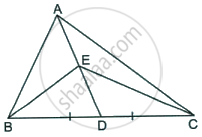
In the adjoining figure, D is the mid-point of BC and E be any point on AD.
Prove that :
- area (ΔEBD) = area (ΔECD).
- area (ΔABE) = area (ΔACE).
Advertisements
Solution
Given: D is the midpoint of BC. E is any point on AD, so E lies on segment AD.
To Prove:
- area (ΔEBD) = area (ΔECD).
- area (ΔABE) = area (ΔACE).
Proof [Step-wise]:
Part (i)
1. BD = DC because D is the midpoint of BC. ...(Given)
2. Triangles EBD and ECD have their bases BD and DC on the same straight line BC and share the same vertex E; hence, they have the same altitude from E to line BC. ...(Triangles with a common vertex and bases on the same line have areas proportional to their bases).
3. Area (ΔEBD) : Area (ΔECD) = BD : DC ...(Areas are proportional to corresponding bases when the vertex is the same).
4. Since BD = DC, the ratio is 1. So, Area (ΔEBD) = Area (ΔECD).
Part (ii)
1. Write area (ΔABE) as area (ΔABD) – area (ΔEBD). ...(Because E lies on AD, so ΔABE is the part of ΔABD remaining after removing ΔEBD).
2. Similarly, area (ΔACE) = area (ΔACD) – area (ΔECD).
3. Since D is the midpoint of BC, triangles ABD and ACD are on the same base AD.
More directly: ABD and ACD have equal bases BD and DC on BC and the same vertex A.
So, area (ΔABD) = area( ΔACD).
4. From part (i), we have area (ΔEBD) = area (ΔECD).
5. Therefore, area (ΔABE)
= area (ΔABD) – area (ΔEBD)
= area (ΔACD) – area (ΔECD)
= area (ΔACE)
