Advertisements
Advertisements
Question
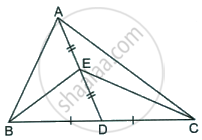
In the adjoining figure; BD = DC and AE = ED. Prove that area of ΔACE = `1/4` × area of ΔАВС.
Advertisements
Solution
Given:
BD = DC, so D is midpoint of BC.
AE = E,D so E is midpoint of AD.
To Prove: Area (ΔACE) = `1/4` × Area (ΔABC).
Proof (Step-wise):
1. Because BD = DC, D is the midpoint of BC.
Hence, triangles ABD and ADC have the same base length on BC (BD = DC) and share the same altitude from A.
So, they have equal areas.
Therefore, area (ΔADC) = `1/2` × area(ΔABC).
2. Consider triangle ADC.
Points A, E, D are collinear with E the midpoint of AD (AE = ED).
Triangles ACE and A D C have the same vertex C and the same altitude from C to the line AD.
So, their areas are proportional to their bases on AD.
Thus, `("Area"(ΔACE))/("Area"(ΔADC)) = (AE)/(AD)`.
Area of a triangle = `1/2` × base × height.
So, area ratios with common height equal base ratios.
3. Since E is the midpoint of AD,
`(AE)/(AD) = 1/2`
From step 2:
area (ΔACE) = `1/2` × area (ΔADC)
4. Combine steps 1 and 3:
Area (ΔACE) = `1/2` × Area (ΔADC)
= `1/2` × `1/2` × area (ΔABC)
= `1/4` × area (ΔABC)
