Advertisements
Advertisements
Question
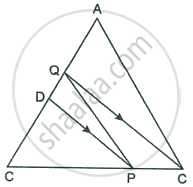
In the adjoining figure, D is the mid-point of AB. P is any point on BC and CQ || PD meets AB at Q.
Prove that : area (ΔBPQ) = `1/2` × area (ΔABC)
Advertisements
Solution
Given: Triangle ABC with D the midpoint of AB. P is any point on BC. Line through C parallel to PD meets AB at Q, so CQ || PD.
To Prove: area (ΔBPQ) = `1/2` × area (ΔABC).
Proof [Step-wise]:
1. Put A at the origin and write vectors AB = u, AC = v.
Then B = u, C = v and `D = 1/2 u`.
Let P lie on BC.
So, P = B + t(C – B) = (1 – t)u + t v for some t(0 < t ≤ 1).
2. Compute the direction vector of PD:
PD = D – P
= `1/2 u - [(1 - t)u + t v]`
= `(t - 1/2)u - t v`
3. Since CQ || PD, the line through C in the direction PD meets AB at a point Q of the form r u (because AB is the line {r u : r ∈ R}).
So, for some scalar s, `r u = v + s[(t - 1/2)u - t v]`.
Writing this equality in the independent vectors u and v gives the two scalar equations `r - s(t - 1/2) = 0` and 1 – s t = 0.
From 1 – s t = 0 we get `s = 1/t` and then `r = s(t - 1/2) = 1 - 1/(2t)`.
Hence, `Q = r u = (1 - 1/(2t)) u`.
4. Form the two side vectors of ΔBPQ based at B:
P – B = t(v – u),
Q – B = (r – 1)u = `-(1/(2t)) u`
5. Area formula using the magnitude of the cross product of the two side vectors:
`"area" (ΔBPQ) = 1/2 |(P - B) × (Q - B)|`
= `1/2 |t(v - u) × (-1/(2t) u)|`
= `1/2 × 1/2 |(v - u) × u|`
= `1/4 |u xx v|`
The cross product u × u = 0 was used.
6. The area of ΔABC is `1/2 |u xx v|`.
Therefore, area (ΔBPQ) = `1/4 |u xx v|`
= `1/2 xx 1/2 |u xx v|`
= `1/2` × area (ΔABC)
