Advertisements
Advertisements
Question
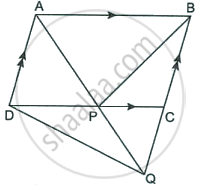
In the adjoining figure, ABCD is a parallelogram. A line through A intersects DC at P and meets BC produced at Q.
Prove that : area (ΔBCP) = area (ΔDPQ).
Advertisements
Solution
Given: ABCD is a parallelogram. A line through A meets DC at P and meets BC produced at Q figure as given.
To Prove: area (ΔBCP) = area (ΔDPQ).
Proof [Step-wise]:
1. Put a convenient coordinate system:
Take A = (0, 0), AB = (1, 0) so B = (1, 0).
Let AD = (x, y) (y ≠ 0), so D = (x, y) and C = B + D = (1 + x, y).
This places DC horizontal at the y-coordinate y.
2. Let the line through A have slope m; its equation is y = mx.
Its intersection with DC the horizontal line y = y gives P:
m × xP = y
⇒ `x_P = y/m`
So, `P = (y/m, y)`.
3. The line BC is the line through B in direction d = AD = (x, y); a parametric point is B + t × d = (1 + tx, ty).
Intersecting this with y = mx the line through A gives
t × y = m(1 + tx)
⇒ `t = m/(y - mx)`
Thus, Q = (1 + tx, ty)
= `(y/(y - mx), (my)/(y - mx))`
4. Use the vector determinant formula for area:
For triangle with vertices U, V, W, area (ΔUVW)
= `1/2 |det (V - U, W - U) |`
For ΔBCP: Take U = B, V = C, W = P.
Then `C - B = (x, y), P - B = (y/m - 1, y)`.
`det (C - B, P - B) = x xx y - y xx (y/m - 1)`
= `xy - (y^2/m) + y`
Hence, `"area" (ΔBCP) = 1/2 xx |xy - y^2/m + y|`.
5. For ΔDPQ: Take U = D, V = P, W = Q.
Then `P - D = (y/m - x, 0)`.
Since Py = Dy = y .
`Q - D = (y/(y - mx) - x, (my)/(y - mx) - y)`
The determinant simplifies because P – D has zero second component:
`det (P - D, Q - D) = (y/(m - x)) xx ((my)/(y - m x) - y)`
Simplify the product:
`(y/(m - x)) xx ((my)/(y - mx) - y)`
= `((y - mx)/m) xx (y(m/(y - mx) - 1))`
= `(y/m) xx (m - y + mx)`
= `xy - y^2/(m + y)`
Thus, `"area" (ΔDPQ) = 1/2 xx |xy - y^2/(m + y)|`.
6. From steps 4 and 5, the two area expressions are equal, so area (ΔBCP) = area (ΔDPQ).
Therefore, area (ΔBCP) = area (ΔDPQ), as required.
