Advertisements
Advertisements
Question
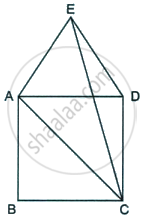
In the adjoining figure, ABCD is a square and ADE is an equilateral triangle. Prove that `∠ACE = 1/2 ∠ DAE`.
Advertisements
Solution
Given:
- ABCD is a square.
- ADE is an equilateral triangle with AD as one side of the equilateral triangle.
To Prove:
- `∠ACE = 1/2 ∠DAE`.
Proof [Step-wise]:
1. Place the square in a coordinate plane for a clean calculation.
Let the side length be 1 and take A = (0, 1), B = (0, 0), C = (1, 0), D = (1, 1).
2. Because triangle ADE is equilateral with base AD of length 1 from A(0, 1) to D(1, 1), the third vertex E lies above the midpoint of AD at height `h = (sqrt(3))/2`.
Thus, `E = (1/2, 1 + sqrt(3)/2)`.
3. Compute the direction angle of CA and CE measured from the positive x-axis.
Vector CA = A – C
= (0 – 1, 1 – 0)
= (–1, 1)
The direction angle of CA is 135°.
Vector CE = E − C
= `(1/2 - 1, 1 + sqrt(3)/2 - 0)`
= `(-1/2, 1 + sqrt(3)/2)`
4. Find the direction angle of CE.
Its slope is slope (CE)
= `(1 + sqrt(3)/2)/(-1/2)`
= `-2(1 + sqrt(3)/2)`
= `-(2 + sqrt(3))`
Note the identity `tan 75° = 2 + sqrt(3)`.
Since tan (45° + 30°)
= `(1 + 1/sqrt(3))/(1 - 1/sqrt(3))`
= `2 + sqrt(3)`
Therefore, arc `tan (2 + sqrt(3)) = 75°`.
So, arc `tan -(2 + sqrt(3)) = -75^circ` and the direction angle of CE in 0° – 360° is 180° – 75° = 105°.
5. Thus, the angle at C between CA and CE is ∠ACE
= Direction (CA) – Direction (CE)
= 135° – 105°
= 30°
6. In triangle ADE (equilateral), we have ∠DAE = 60°.
Hence, ∠ACE = 30°
= `1/2 xx 60^circ`
= `1/2 ∠DAE`
`∠ACE = 1/2 ∠DAE`, as required.
