Advertisements
Advertisements
Question
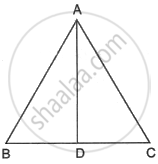
In the adjoining figure, AB = AC and D is the mid-point of BC. Use SSS criteria of congruency and prove that:
- ΔABD ≅ ΔACD
- AD bisects ∠A.
- AD is perpendicular to BC.
Advertisements
Solution
Given:
- In triangle ABC, AB = AC (so ABC is isosceles with apex A).
- D is the midpoint of BC (so BD = DC).
To Prove:
- ΔABD ≅ ΔACD
- AD bisects ∠A (i.e. ∠BAD = ∠DAC)
- AD is perpendicular to BC (AD ⟂ BC).
Proof [Step-wise]:
1. BD = DC because D is the midpoint of BC. ...(Given)
2. AB = AC. ...(Given)
3. AD = AD. ...(Common side to triangles ABD and ACD)
4. From (1), (2), (3) the three pairs of corresponding sides are equal:
AB = AC
BD = DC
AD = AD
Hence by SSS congruence, ΔABD ≅ ΔACD.
5. From the congruence in step 4, corresponding parts of congruent triangles are equal (CPCTC).
In particular ∠BAD = ∠DAC.
Therefore AD bisects ∠A.
This proves (ii).
6. Also by congruence, the angles at D in the two triangles are equal:
∠ADB = ∠ADC.
These two angles are adjacent and lie on a straight line BC, so ∠ADB + ∠ADC = 180° they form a linear pair.
7. If two adjacent angles are equal and sum to 180°, each must be 90°.
Thus ∠ADB = ∠ADC = 90°, so AD is perpendicular to BC.
This proves (iii).
