Advertisements
Advertisements
Question
In the political scenario of 1939, important developments took place in India and abroad. In this context, mention the circumstances which led to the passage of the Act of 1935?
Advertisements
Solution
The following circumstances led to the passage of the Act of 1935:
(i) The Third Round Table Conference held in November-December 1932 issued a white paper in March 1993 which gave details of the working of the new constitution promulgated under the Act.
(ii) The Poona Pact which had replaced the Communal Award had doubled the number of seats for backward classes which were to the filled by a common joint electorate. The Act of 1935 was its first testing ground.
(iii) In June 1933 Gandhiji suspended the Civil Disobedience Movement and it was finally withdrawn in May 1935. The British now wanted to appease the leader with some constitutional reforms.
RELATED QUESTIONS
The Quit India Resolution in 1942 was one of the final calls given by Gandhi for the British to leave India. Moving towards Independence, Lord Mountbatten’s Plan was significant. In this context, answer the following:
Give any three effects of the Quit India Movement launched by Gandhi in 1942 that was significant to the last phase of the National Movement of India.
Why was the Government of India Act, 1935 passed?
Give any one proposal of Cripps Mission.
What was the Day of Deliverance?
State any two important proposals of Crippse offer?
What is meant by ‘Mass struggle on non-violent lines’? Which resolution was passed on the 8th of August, 1942 leading to a mass struggle on non-violent lines?
Japanese success in the East prompted the British Government to send the Cripps Mission to India. In this context, state the proposals of the Cripps Mission.
Which resolution was passed on 8th August, 1942 leading to a mass struggle on non-violent lines? State any two reasons behind the launching of this movement.
What was the impact and significance of Quit India Movement.
Answer the following: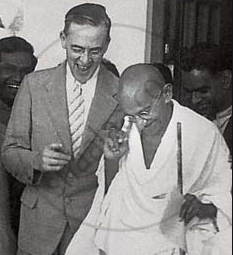
(i) Name the male personality in the picture with Gandhi given alongside.
(ii) Why Britain Prime Minister sent this gentleman to India?
