Advertisements
Advertisements
Question
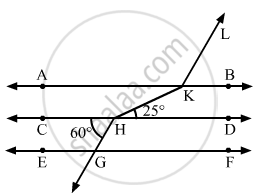
In the given figure, AB || CD || EF and GH || KL. The measure of ∠HKL is
Options
85°
135°
145°
215°
Advertisements
Solution
The given figure is as follows:
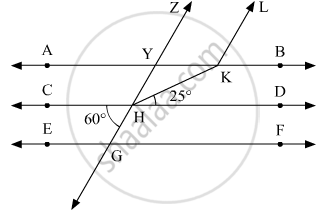
Let us extend GH to meet AB at Y.
We have the following:
∠CHG and∠CHY are the supplementary angles. Therefore,
∠CHY +∠CHG =180°
∠CHY = 180° -∠CHG
= 180° - 60°
= 120°
∠CHY = 120° .... (1)
Since,AB||CD. Thus, ∠DHKand ∠YKHare the interior alternate angles.
Therefore,
∠DHK = ∠YKH
∠YKH = 25° .... (2)
Since, AB || CD. Thus, ∠CHY and ∠AYZare the corresponding angles.
Therefore,
∠CHY = ∠AYZ
From (1), we get:
∠AYZ = 120° ……(3)
Since ∠YZ || KL. Thus ∠AYZ and ∠YKL are corresponding angles,
Therefore,
∠AYZ = ∠YKL
∠YKL = 120° .... (4)
Thus, the required angle x can be calculated as:
x = ∠YKL + ∠YKH
From (3) and (4) we get:
x = 25° + 120°
x= 145°
APPEARS IN
RELATED QUESTIONS
If an angle is 30° more than one half of its complement, find the measure of the angle.
Fill in the blank so as to make the following statement true:
A ray stands on a line, then the sum of the two adjacent angles so formed is ______
If two straight lines intersect each other, prove that the ray opposite to the bisector of one of the angles thus formed bisects the vertically opposite angle.
An angle is equal to five times its complement. Determine its measure.
State, true or false:
A line segment 4 cm long can have only 2000 points in it.
out of \[\overleftrightarrow{AB},\overrightarrow{AB},\overleftarrow{AB}\] and `overline(AB)` which one has a fixed length?
Find y in the given figure.
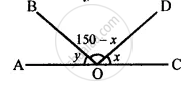
In the given figure, find ∠PQR.
Write the complement of (x + 5)°
In the given figure, the arrows indicate parallel lines. State which angles are equal. Give a reason.