Advertisements
Advertisements
Question
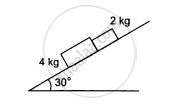
In the following figure shows two blocks in contact sliding down an inclined surface of inclination 30°. The friction coefficient between the block of mass 2.0 kg and the incline is μ1, and that between the block of mass 4.0 kg and incline is μ2. Calculate the acceleration of the 2.0 kg block if (a) μ1 = 0.20 and μ2 = 0.30, (b) μ1 = 0.30 and μ2 = 0.20. Take g = 10 m/s2.
Advertisements
Solution
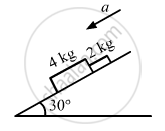
(a) From the free body diagram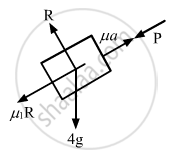
R = 4g cos 30°
`=>"R"=4xx10xxsqrt3/2`
`= 20sqrt3"N"` (1)
μ2R + m1a − p − m1g sin θ = 0
μ2R + 4a − p − 4g sin 30° = 0
⇒ 0.3 x (40) cos 30° + 4a − p − 40 sin 30° = 20 (2)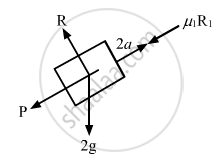
R1 = 2g cos 30° = 10√3 (3)
p + 2a − μ1R1 − 2g sin 30° = 0 (4)
From Equation (2),
`6sqrt3+4a-p-20=0`
From Equation (4),
`p+2a+2sqrt3-10=10`
`6sqrt3+6a+30+2sqrt3=0`
`=>6a=30-8sqrt3`
=30 - 13.85=16.15
`=>a=16.15/6`
= 2.69 = 2.7 m/s2
(b) In this case, the 4 kg block will move at a higher acceleration because the coefficient of friction is less than that of the 2 kg block. Therefore, the two blocks will move separately. By drawing the free body diagram of 2 kg mass, it can be shown that a = 2.4 m/s2.
