Advertisements
Advertisements
Question
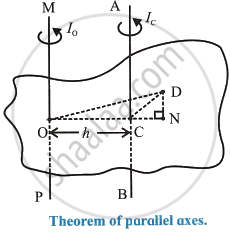
In Fig., the point D is chosen such that we have to extend OC for the perpendicular DN to fall on it. What will happen to the final expression of Io, if point D is so chosen that the perpendicular DN falls directly on OC?
Advertisements
Solution
If point D is chosen such that the perpendicular DN falls directly on OC, then the geometrical construction changes, but the final result of the theorem of parallel axes remains unchanged.
For parallel axes,
IO = IC + Mh2
where:
IO = moment of inertia about the axis through O
IC = moment of inertia about the parallel axis through C
h = OC = perpendicular distance between the two axes
Choosing D differently only changes the intermediate geometrical relation used in the derivation. The cross-term still vanishes because C is the centre of mass.
Hence, the final expression is still:
IO = IC + Mh2
So, the final expression remains unchanged.
