Advertisements
Advertisements
Question
In an isosceles triangle, two angles are always ______.
Advertisements
Solution
In an isosceles triangle, two angles are always equal.
Explanation:
In an isosceles triangle, two angles are always equal.
Since, if two sides are equal, then the angles opposite them are equal.
APPEARS IN
RELATED QUESTIONS
Find the area of an equilateral triangle of side 20 cm.
Find the area of an equilateral triangle having perimeter of 18cm.
Find the area of the shaded region in the figure as shown, in which DPQS is an equilateral triangle and ∠PQR = 90°.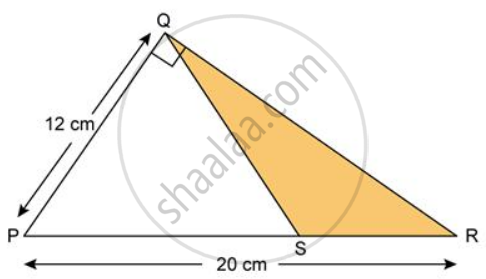
In a right-angled triangle PQR right-angled at Q, QR = x cm, PQ = (x + 7) cm and area = 30 cm2. Find the sides of the triangle.
Find the base of an isosceles triangle whose area is 192cm2 and the length of one of the equal sides is 20cm.
Each equal side of an isosceles triangle is 3cm less than the unequal side. The height of the perpendicular from the vertex to the unequal side is 3cm less than the equal side. If the area of the isosceles triangle is 108cm2, find the perimeter of the triangle.
A wire when bent in the form of a square encloses an area of 16 cm2. Find the area enclosed by it when the same wire is bent in the form of an equilateral triangle
A chessboard contains 64 equal square and the area of each square is 6.25cm2. A 2cm wide border is left inside of the board. Find the length of the side of the chessboard.
The cross-section of a canal is a trapezium in shape. If the canal is 10m wide at the top, 6m wide at the bottom and the area of cross-section is 72 sq.m, determine its depth.
Each of the equal sides of an isosceles triangle is 4 cm greater than its height. If the base of the triangle is 24 cm; calculate the perimeter and the area of the triangle.
