Advertisements
Advertisements
Question
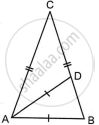
In ΔABC, AC = BC. ∠BAC is bisected by AD and AD = AB. Find ∠ACB.
Advertisements
Solution
Given:
△ABC is isosceles with AC = BC.
∠BAC is bisected by AD, meaning ∠BAD = ∠DAC.
AD = AB.
We need to find ∠ACB.
Step 1: Label the angles and sides
Since △ABC is isosceles with AC = BC, we know:
∠ABC = ∠ACB ...(Because in an isosceles triangle, base angles are equal)
Let ∠ABC = ∠ACB = x.
Step 2: Use the Angle Bisector Property
Since AD bisects ∠BAC, we have:
∠BAD = ∠DAC
Let ∠BAD = ∠DAC = y.
Thus, the total angle ∠BAC = 2y.
Step 3: Use the triangle angle sum property
The sum of angles in any triangle is 180°.
In △ABC, we have:
∠BAC + ∠ABC + ∠ACB = 180°
Substitute the known angles:
2y + x + x = 180°
2y + 2x = 180°
y + x = 90° ...(Equation 1)
Step 4: Use the fact that AD = AB
Since AD = AB, ΔABD is isosceles,
So, ∠ABD = ∠ADB = z
Also, since ∠ADB + ∠BAD = 180° sum of angles on a straight line:
z + y = 180°
Thus, z = 180° – y.
Step 5: Relating x and y
In △ABC, the sum of the angles is 180°:
∠ABC + ∠ACB + ∠BAC = 180°
Since ∠ABC = ∠ACB = x and ∠BAC = 2y, we have:
2x + 2y = 180°
x + y = 90°
Thus, x = 36°.
So, ∠ACB = 36°.
