Advertisements
Advertisements
Question
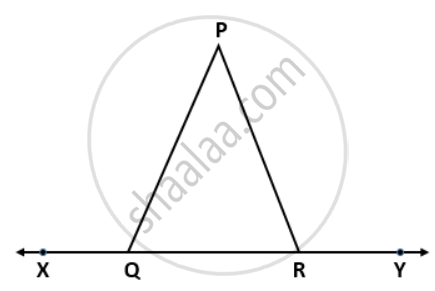
In a triangle PQR, ∠P + ∠Q = 130° and ∠P + ∠R = 120°. Calculate each angle of the triangle.
Advertisements
Solution

In ΔPQR,
∠P + ∠Q = 130° ....(given)
Now, ∠P + ∠Q = ∠PRY ....(Exterior angle property)
⇒ ∠PRY = 130°
∠PRY + ∠R = 180° ....(Linear pair)
⇒ 130° + ∠R = 180°
⇒ ∠R = 180° - 130° = 50°
Also, ∠P + ∠R = 120° ....(given)
Now, ∠P + ∠R = ∠PQX ....(Exeterior angle property)
⇒ ∠PQx = 120°
∠PQX +∠Q = 180° ....(Linear pair)
⇒ 120°+ ∠Q = 180°
⇒ ∠Q = 180° - 120° = 60°
In ΔPQR,
∠P + ∠Q + ∠R = 180° ....(Angle sum property of a triangle)
⇒ ∠P + 60° + 50° = 180°
⇒ ∠P = 180° - 110° = 70°
Thus, the angles of ΔPQR are as follows:
∠P = 70°, ∠Q = 60° and ∠R = 50°.
APPEARS IN
RELATED QUESTIONS
In the given figure, ∠Q: ∠R = 1: 2. Find:
a. ∠Q
b. ∠R
The exterior angles, obtained on producing the side of a triangle both ways, are 100° and 120°. Find all the angles of the triangle.
Use the given figure to find the value of x in terms of y. Calculate x, if y = 15°.
Use the given figure to find the value of y in terms of p, q and r.
In the figure given below, if RS is parallel to PQ, then find the value of ∠y.
Use the given figure to show that: ∠p + ∠q + ∠r = 360°.
In a triangle ABC, if the bisectors of angles ABC and ACB meet at M then prove that: ∠BMC = 90° + `(1)/(2)` ∠A.
If bisectors of angles A and D of a quadrilateral ABCD meet at 0, then show that ∠B + ∠C = 2 ∠AOD
If the angles of a triangle are in the ratio 2: 4: 6; show that the triangle is a right-angled triangle.
In a triangle, the sum of two angles is 139° and their difference is 5°; find each angle of the triangle.