Advertisements
Advertisements
Question
If the heights of 500 students are normally distributed with mean 68.0 inches and standard deviation 3.0 inches, how many students have height less than or equal to 64 inches
Advertisements
Solution
Let x denote the height of a student N = 500; m = 68.0 inches and σ = 3.0 inches the standard normal variate
z = `(x - mu)/sigma = (x - 68)/3`
P(Less than or equal to 64 inches)
P(X ≤ 64)
When x = 64
z = `(64 - 68)/3 = (-4)/3 = - 1.33`
P(X ≤ 64) = P(Z ≤ – 1.33)
P(Z ≥ – 1.33)
= 0.5 – 0.4082
= 0.0918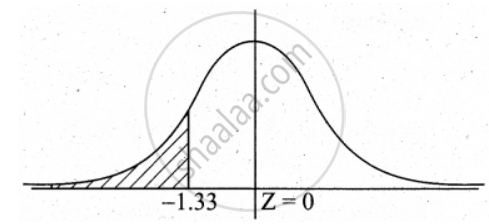
∴ Number of heights who ate less than or equal to 64 inches
= 0.0918 × 500
= 45.9
= 46 .......(approximately)
APPEARS IN
RELATED QUESTIONS
If 18% of the bolts produced by a machine are defective, determine the probability that out of the 4 bolts chosen at random none will be defective
Forty percent of business travellers carry a laptop. In a sample of 15 business travelers, what is the probability that 3 will have a laptop?
Forty percent of business travellers carry a laptop. In a sample of 15 business travelers, what is the probability that 12 of the travelers will not have a laptop?
Derive the mean and variance of poisson distribution
The distribution of the number of road accidents per day in a city is poisson with mean 4. Find the number of days out of 100 days when there will be at most 3 accidents
Choose the correct alternative:
Using the standard normal table, the sum of the probabilities to the right of z = 2.18 and to the left of z = – 1.75 is
Choose the correct alternative:
Monthly expenditure on their credit cards, by credit cardholders from a certain bank, follows a normal distribution with a mean of ₹ 1,295.00 and a standard deviation of ₹ 750.00. What proportion of credit cardholders spend more than ₹ 1,500.00 on their credit cards per month?
Choose the correct alternative:
If P(Z > z) = 0.5832 what is the value of z (z has a standard normal distribution)?
Entry to a certain University is determined by a national test. The scores on this test are normally distributed with a mean of 500 and a standard deviation of 100. Raghul wants to be admitted to this university and he knows that he must score better than at least 70% of the students who took the test. Raghul takes the test and scores 585. Will he be admitted to this university?
The annual salaries of employees in a large company are approximately normally distributed with a mean of $50,000 and a standard deviation of $20,000. What percent of people earn less than $40,000?
