Advertisements
Advertisements
Question
If sin A = `3/5` and cos B = `9/41 0 < "A" < pi/2, 0 < "B" < pi/2`, find the value of sin(A + B)
Advertisements
Solution
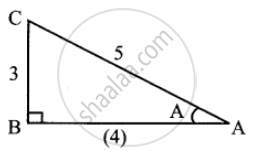
sin A = `3/5`
`0 < "A" < pi/2`
From ΔABC, AB = `sqrt(5^2 - 3^2)`
= `sqrt(25 - 9)`
= `sqrt(16)`
= 4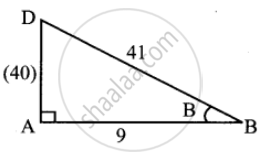
cos B = `9/41`
`0 < "B" < pi/2`
From ΔBAD, AD = `sqrt(41^2 - 9^2)`
= `sqrt((41 + 9)(41 - 9))`
= `sqrt(50 xx 32)`
= `sqrt(100 xx 16)`
= `sqrt(10^2 xx 4^2)`
= 10 × 4
= 40
Now,
From ΔABC, sin A = `3/5`, cos A = `4/5`
From ΔABD, sin B = `40/41`, cos B = `9/41`
sin(A + B) = sin A cos B + cos a sin B
= `(3/5 xx 9/4) + (4/5 xx 40/41)`
= `27/205 + 60/205`
= `187/205`
APPEARS IN
RELATED QUESTIONS
Find the values of cot(660°)
Find the value of the trigonometric functions for the following:
cos θ = `2/3`, θ lies in the I quadrant
If sin x = `15/17` and cos y = `12/13, 0 < x < pi/2, 0 < y < pi/2` find the value of sin(x + y)
If sin A = `3/5` and cos B = `9/41, 0 < "A" < pi/2, 0 < "B" < pi/2`, find the value of cos(A – B)
Find the value of tan `(7pi)/12`
Prove that sin(π + θ) = − sin θ.
If a cos(x + y) = b cos(x − y), show that (a + b) tan x = (a − b) cot y
Prove that cos(A + B) cos(A – B) = cos2A – sin2B = cos2B – sin2A
Show that cos2 A + cos2 B – 2 cos A cos B cos(A + B) = sin2(A + B)
If tan x = `"n"/("n" + 1)` and tan y = `1/(2"n" + 1)`, find tan(x + y)
If θ is an acute angle, then find `cos (pi/4 + theta/2)`, when sin θ = `8/9`
Prove that `tan (pi/4 + theta) - tan(pi/4 - theta)` = 2 tan 2θ
Prove that (1 + sec 2θ)(1 + sec 4θ) ... (1 + sec 2nθ) = tan 2nθ
Show that sin 12° sin 48° sin 54° = `1/8`
Show that `cos pi/15 cos (2pi)/15 cos (3pi)/15 cos (4pi)/15 cos (5pi)/15 cos (6pi)/15 cos (7pi)/15 = 1/128`
Show that `(sin 8x cos x - sin 6x cos 3x)/(cos 2x cos x - sin 3x sin 4x)` = tan 2x
Prove that `(sin 4x + sin 2x)/(cos 4x + cos 2x)` = tan 3x
If A + B + C = 180◦, prove that sin 2A + sin 2B + sin 2C = 4 sin A sin B sin C
