Advertisements
Advertisements
प्रश्न
If sin A = `3/5` and cos B = `9/41 0 < "A" < pi/2, 0 < "B" < pi/2`, find the value of sin(A + B)
Advertisements
उत्तर
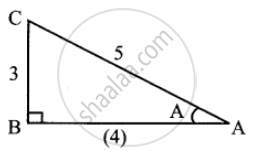
sin A = `3/5`
`0 < "A" < pi/2`
From ΔABC, AB = `sqrt(5^2 - 3^2)`
= `sqrt(25 - 9)`
= `sqrt(16)`
= 4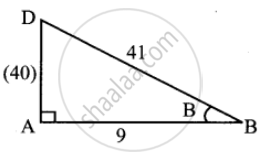
cos B = `9/41`
`0 < "B" < pi/2`
From ΔBAD, AD = `sqrt(41^2 - 9^2)`
= `sqrt((41 + 9)(41 - 9))`
= `sqrt(50 xx 32)`
= `sqrt(100 xx 16)`
= `sqrt(10^2 xx 4^2)`
= 10 × 4
= 40
Now,
From ΔABC, sin A = `3/5`, cos A = `4/5`
From ΔABD, sin B = `40/41`, cos B = `9/41`
sin(A + B) = sin A cos B + cos a sin B
= `(3/5 xx 9/4) + (4/5 xx 40/41)`
= `27/205 + 60/205`
= `187/205`
APPEARS IN
संबंधित प्रश्न
Find the values of sin(480°)
Find the values of cos(300°)
Find the values of cot(660°)
Find the value of the trigonometric functions for the following:
tan θ = −2, θ lies in the II quadrant
If sin x = `15/17` and cos y = `12/13, 0 < x < pi/2, 0 < y < pi/2`, find the value of tan(x + y)
Prove that sin(45° + θ) – sin(45° – θ) = `sqrt(2) sin θ`
Prove that sin(30° + θ) + cos(60° + θ) = cos θ
Prove that cos 8θ cos 2θ = cos25θ – sin23θ
Show that tan(45° + A) = `(1 + tan"A")/(1 - tan"A")`
Find the value of cos 2A, A lies in the first quadrant, when tan A `16/63`
Prove that cos 5θ = 16 cos5θ – 20 cos3θ + 5 cos θ
Prove that (1 + sec 2θ)(1 + sec 4θ) ... (1 + sec 2nθ) = tan 2nθ
Prove that `32(sqrt(3)) sin pi/48 cos pi/48 cos pi/24 cos pi/12 cos pi/6` = 3
Express the following as a product
cos 35° – cos 75°
Show that sin 12° sin 48° sin 54° = `1/8`
Prove that cos(30° – A) cos(30° + A) + cos(45° – A) cos(45° + A) = `cos 2"A" + 1/4`
Prove that `(sin(4"A" - 2"B") + sin(4"B" - 2"A"))/(cos(4"A" - 2"B") + cos(4"B" - 2"A"))` = tan(A + B)
If A + B + C = `pi/2`, prove the following cos 2A + cos 2B + cos 2C = 1 + 4 sin A sin B sin C
Choose the correct alternative:
Let fk(x) = `1/"k" [sin^"k" x + cos^"k" x]` where x ∈ R and k ≥ 1. Then f4(x) − f6(x) =
