Advertisements
Advertisements
Question
If N ÷ 5 leaves remainder 3 and N ÷ 2 leaves remainder 0, then N ÷ 10 leaves remainder 4.
Options
True
False
Advertisements
Solution
This statement is False.
Explanation:
Here it’s given N ÷ 5 leaves remainder 3
⇒ N = 5n + 3,where n = 0, 1, 2, 3, ...
And N ÷ 2 leaves remainder 0
⇒ N is an even number
But N = 5n + 3, it’s sum of two terms whose second term is odd.
Therefore, 5n should be an odd number.
5n can be odd when n = 1, 3, 5, ...
So, in this case when N = 5n + 3
⇒ N = 5(1) + 3 = 8 when (n = 1)
Hence when we substitute n = 1, 3, 5, ... in N = 5n + 3, we get 8, 18, 28 etc
Now, when we divide N by 10, N can be written as
N = 10 × n + 8, when n = 0, 1, 2, 3, ...
Therefore, when N ÷ 10, always leaves remainder 8.
APPEARS IN
RELATED QUESTIONS
Find the quotient when the difference of 985 and 958 is divided by 9.
Which of the following statement is true?
If a number is divisible by 8, it must be divisible by 4.
Which of the following statement is true?
A number is divisible by 18, if it is divisible by both 3 and 6.
Do you remember magic triangles? Come now, let s make some magic squares.
- Fill this square using all the numbers from 21 to 29.
Rule: The total of each side is 75.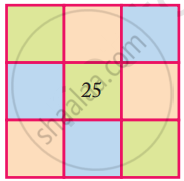
Now you try and change these numbers into special numbers —
273
The difference of three-digit number and the number obtained by putting the digits in reverse order is always divisible by 9 and ______.
If a 3-digit number abc is divisible by 11, then ______ is either 0 or multiple of 11.
If AB × 4 = 192, then A + B = 7.
756x is a multiple of 11, find the value of x.
Fill in the blank space in the same way.

