If α and β are the zeros of the quadratic polynomial p(y) = 5y^2 – 7y + 1, find the value of 1/α + 1/β.
Advertisements
Question
If α and β are the zeros of the quadratic polynomial p(y) = 5y2 – 7y + 1, find the value of `1/α + 1/β`.
Advertisements
Solution
Since α and β are the zeroes of the polynomials
p(y) = 5y2 – 7y + 1
Sum of the zeroes `alpha+beta="-coeeficient of x"/("coefficient of "x^2)`
`=-(-7)/5`
`=7/5`
Product of zeroes `=alphabeta="constant term"/"coefficient of "x^2`
`=1/5`
We have, `1/alpha+1/beta=(alpha+beta)/(alphabeta)`
By substituting `alpha+beta=7/5` and `alphabeta=1/5` we get,
`1/alpha+1/beta=(7/5)/(1/5)`
`1/alpha+1/beta=7/5xx5/1`
`1/alpha+1/beta=7`
Hence, the value of `1/alpha+1/beta` is 7.
APPEARS IN
RELATED QUESTIONS
Verify that the numbers given along side of the cubic polynomials below are their zeroes. Also verify the relationship between the zeros and the coefficients.
g(x) = x3 – 4x2 + 5x – 2; 2, 1, 1
If the zeroes of the polynomial x3 – 3x2 + x + 1 are a – b, a, a + b, find a and b
Find the zeros of the following quadratic polynomial and verify the relationship between the zeros and the coefficients:
`q(x) = sqrt(3)x^2 + 10x + 7sqrt(3)`
If α and β are the zeros of the quadratic polynomial f(x) = ax2 + bx + c, then evaluate α2β + αβ2
If α and β are the zeros of the quadratic polynomial f(x) = x2 – p(x + 1) – c, show that (α + 1)(β + 1) = 1 – c.
Find the zeroes of the quadratic polynomial 4x2 – 4x + 1 and verify the relation between the zeroes and the coefficients.
Verify that 3, –2, 1 are the zeros of the cubic polynomial p(x) = (x3 – 2x2 – 5x + 6) and verify the relation between it zeros and coefficients.
If 3 and –3 are two zeroes of the polynomial (x4 + x3 – 11x2 – 9x + 18), find all the zeroes of the given polynomial.
If two zeros x3 + x2 − 5x − 5 are \[\sqrt{5}\ \text{and} - \sqrt{5}\], then its third zero is
The polynomial which when divided by −x2 + x − 1 gives a quotient x − 2 and remainder 3, is
If p(x) = axr + bx + c, then –`"b"/"a"` is equal to ______.
Case Study -1
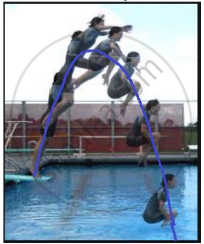
The figure given alongside shows the path of a diver, when she takes a jump from the diving board. Clearly it is a parabola.
Annie was standing on a diving board, 48 feet above the water level. She took a dive into the pool. Her height (in feet) above the water level at any time ‘t’ in seconds is given by the polynomial h(t) such that h(t) = -16t2 + 8t + k.
The zeroes of the polynomial r(t) = -12t2 + (k - 3)t + 48 are negative of each other. Then k is ______.
Find the zeroes of the following polynomials by factorisation method and verify the relations between the zeroes and the coefficients of the polynomials:
4x2 – 3x – 1
Find the zeroes of the following polynomials by factorisation method and verify the relations between the zeroes and the coefficients of the polynomials:
5t2 + 12t + 7
Find the zeroes of the following polynomials by factorisation method and verify the relations between the zeroes and the coefficients of the polynomials:
`y^2 + 3/2 sqrt(5)y - 5`
A quadratic polynomial the sum and product of whose zeroes are – 3 and 2 respectively, is ______.
Find the zeroes of the quadratic polynomial x2 + 6x + 8 and verify the relationship between the zeroes and the coefficients.
If α, β are zeroes of quadratic polynomial 5x2 + 5x + 1, find the value of α2 + β2.
For the cubic equation \[ ax^{3} + bx^{2} + cx + d = 0 \] with roots \[ \alpha, \beta, \gamma \], the sum of the roots \( \alpha + \beta + \gamma \) is:
For the cubic equation \[ ax^{3} + bx^{2} + cx + d = 0 \] with roots \[ \alpha, \beta, \gamma \], the pairwise product \( \alpha\beta + \beta\gamma + \gamma\alpha \) equals:
