If α and β are the zeros of a quadratic polynomial such that α + β = 24 and α – β = 8, find a quadratic polynomial having α and β as its zeros.
Advertisements
Question
If α and β are the zeros of a quadratic polynomial such that α + β = 24 and α – β = 8, find a quadratic polynomial having α and β as its zeros.
Advertisements
Solution
Given
α + β = 24 ..............(i)
α − β = 8 ..............(ii)
By subtracting equation (ii) from (i) we get
α + β = 24
α − β = 8
--------------
2α = 32
`alpha=32/2`
α = 16
Substituting α = 16 in equation (i) we get,
α + β = 24
16 + β = 24
β = 24 - 16
β = 8
Let S and P denote respectively the sum and product of zeros of the required polynomial. then,
S = α + β
= 16 + 8
= 24
P = αβ
= 16 x 8
= 128
Hence, the required polynomial if f(x) is given by
f(x) = k(x2 - Sx + P)
f(x) = k(x2 -24x + 128)
Hence, required equation is f(x) = k(x2 - 24x + 128) where k is any non-zeros real number.
APPEARS IN
RELATED QUESTIONS
Find the zeroes of the following quadratic polynomial and verify the relationship between the zeroes and the coefficients:
3x2 – x – 4
Find a quadratic polynomial with the given numbers as the sum and product of its zeroes respectively.
4, 1
If a and are the zeros of the quadratic polynomial f(x) = 𝑥2 − 𝑥 − 4, find the value of `1/alpha+1/beta-alphabeta`
If α and β are the zeros of the quadratic polynomial p(x) = 4x2 – 5x – 1, find the value of α2β + αβ2.
If a and 3 are the zeros of the quadratic polynomial f(x) = x2 + x − 2, find the value of `1/alpha-1/beta`.
If α and β are the zeros of the quadratic polynomial f(x) = x2 – px + q, prove that `alpha^2/beta^2 + beta^2/alpha^2 = p^4/q^2 - (4p^2)/q + 2`.
If α and β are the zeros of the quadratic polynomial f(x) = x2 – 1, find a quadratic polynomial whose zeros are `(2alpha)/beta` and `(2beta)/alpha`.
If α and β are the zeros of the quadratic polynomial f(x) = x2 – p(x + 1) – c, show that (α + 1)(β + 1) = 1 – c.
If If α and β are the zeros of the quadratic polynomial f(x) = x2 – 2x + 3, find a polynomial whose roots are α + 2, β + 2.
Find the condition that the zeros of the polynomial f(x) = x3 + 3px2 + 3qx + r may be in A.P.
Find the quadratic polynomial whose zeroes are `2/3` and `-1/4` Verify the relation between the coefficients and the zeroes of the polynomial.
Find the quadratic polynomial, sum of whose zeroes is 8 and their product is 12. Hence, find the zeroes of the polynomial.
Verify that 3, –2, 1 are the zeros of the cubic polynomial p(x) = (x3 – 2x2 – 5x + 6) and verify the relation between it zeros and coefficients.
Basketball and soccer are played with a spherical ball. Even though an athlete dribbles the ball in both sports, a basketball player uses his hands and a soccer player uses his feet. Usually, soccer is played outdoors on a large field and basketball is played indoor on a court made out of wood. The projectile (path traced) of soccer ball and basketball are in the form of parabola representing quadratic polynomial.

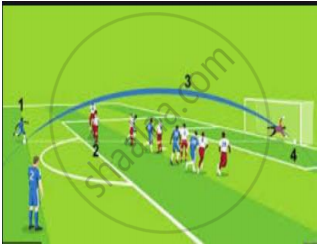
What will be the expression of the polynomial?
Can the quadratic polynomial x2 + kx + k have equal zeroes for some odd integer k > 1?
Given that `sqrt(2)` is a zero of the cubic polynomial `6x^3 + sqrt(2)x^2 - 10x - 4sqrt(2)`, find its other two zeroes.
If the zeroes of the polynomial x2 + px + q are double in value to the zeroes of the polynomial 2x2 – 5x – 3, then find the values of p and q.
If α, β are zeroes of quadratic polynomial 5x2 + 5x + 1, find the value of α–1 + β–1.
In the relation between zeroes (roots) and coefficients of \[ ax^{2} + bx + c = 0 \], what is the status of the pairwise product of the roots?
