Advertisements
Advertisements
Question
if `A = ((2,3,1),(1,2,2),(-3,1,-1))`, Find `A^(-1)` and hence solve the system of equations 2x + y – 3z = 13, 3x + 2y + z = 4, x + 2y – z = 8
Advertisements
Solution
We have `A = [(2,3,1),(1,2,2),(-3,1,-1)]`
`". |A| = [(2,3,1),(1,2,2),(-3,1,-1)]`
=2(−2 −2) − 3(−1 + 6) +1(1 + 6)
=−8 − 15 + 7=−16 ≠ 0
So, A is invertible.
Let Cij be the co-factors of the elements aij in A[aij]. Then,
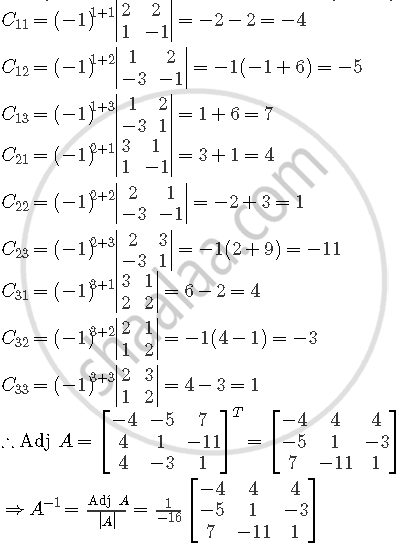
Now, the given system of equations is expressible as
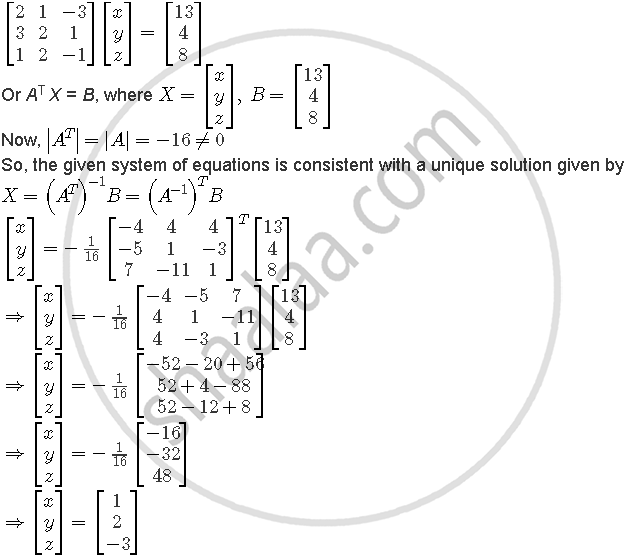 Hence, x = 1, y = 2 and z = −3 is the required solution.
APPEARS IN
RELATED QUESTIONS
Two schools P and Q want to award their selected students on the values of discipline, politeness and punctuality. The school P wants to award Rs x each, Rs y each and Rs z each for the three respective values to its 3, 2 and 1 students with a total award money of Rs 1,000. School Q wants to spend Rs 1,500 to award its 4, 1 and 3 students on the respective values (by giving the same award money for the three values as before). If the total amount of awards for one prize on each value is Rs 600, using matrices, find the award money for each value.
Apart from the above three values, suggest one more value for awards.
A school wants to award its students for the values of Honesty, Regularity and Hard work with a total cash award of Rs 6,000. Three times the award money for Hard work added to that given for honesty amounts to Rs 11,000. The award money given for Honesty and Hard work together is double the one given for Regularity. Represent the above situation algebraically and find the award money for each value, using matrix method. Apart from these values, namely, Honesty, Regularity and Hard work, suggest one more value which the school must include for awards.
Find the inverse of each of the matrices, if it exists.
`[(1,3),(2,7)]`
Find the inverse of each of the matrices, if it exists.
`[(2,7),(1,4)]`
Find the inverse of each of the matrices, if it exists.
`[(2,5),(1,3)]`
Find the inverse of each of the matrices, if it exists.
`[(3,1),(5,2)]`
Find the inverse of each of the matrices, if it exists.
[(3,10),(2,7)]
Find the inverse of each of the matrices, if it exists.
`[(2, -6),(1, -2)]`
Find the inverse of each of the matrices, if it exists.
`[(6,-3),(-2,1)]`
Find the inverse of each of the matrices, if it exists.
`[(2,1),(4,2)]`
Find the inverse of each of the matrices, if it exists.
`[(2,0,-1),(5,1,0),(0,1,3)]`
If A is a 3 × 3 invertible matrix, then what will be the value of k if det(A–1) = (det A)k
Two schools P and Q want to award their selected students on the values of tolerance, kindness and leadership. School P wants to award Rs x each, Rs y each and Rs z each for the three respective values to 3, 2 and 1 students, respectively, with a total award money of Rs 2,200. School Q wants to spend Rs 3,100 to award 4, 1 and 3 students on the respective values (by giving the same award money to the three values as school P). If the total amount of award for one prize on each value is Rs 1,200, using matrices, find the award money for each value.
Find inverse, by elementary row operations (if possible), of the following matrices
`[(1, 3),(-5, 7)]`
If A and B are invertible matrices of the same order, then (AB)-1 is equal to ____________.
A matrix in which the number of rows are equal to the number of columns is said to be a
A square matrix \(A\) of order \(m \times m\) is called invertible (or non-singular) when there exists a square matrix \(B\) of the same order such that which condition holds?
If \(B\) satisfies \[AB=BA=I\] for a square matrix \(A\), what is \(B\) called and how is it denoted?
If \(A\) is invertible, which pair of equations must \[A^{-1}\] satisfy?
Let \(B\) and \(C\) be two inverses of a square matrix \(A\). Which chain correctly proves that \(B=C\)?
If \(A\) and \(B\) are invertible matrices of the same order, which expression is the inverse of \(AB\)?
Given \[\mathbf{A}=\begin{bmatrix}2&3\\1&2\end{bmatrix}\] and \[\mathbf{B}=\begin{bmatrix}2&-3\\-1&2\end{bmatrix}\], if \[\mathbf{A}\mathbf{B}=\mathbf{B}\mathbf{A}=I\], which statement is correct?
What do rectangular matrices possess with respect to inverses?
