Advertisements
Advertisements
Question
If A(1, 2, 3) and B(4, 5, 6) are two points, then find the foot of the perpendicular from the point B to the line joining the origin and the point A.
Sum
Advertisements
Solution
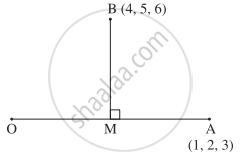
Let M be the foot of the perpendicular drawn from B to the line joining O and A.
Let M = (x, y, z)
OM has direction ratios x - 0, y - 0, z - 0 = x, y, z
OA has direction ratios 1 - 0, 2 - 0, 3 - 0 = 1, 2, 3
But O, M, A are collinear.
∴ `"x"/1 = "y"/2 = "z"/3 = "k"` ....(Let)
∴ x = k, y = 2k, z = 3k
∴ m = (k, 2k, 3k)
BM has direction ratios
k - 4, 2k - 5, 3k - 6
∵ BM is perpendicular to OA.
∴ (1)(k - 4) + 2(2k - 5) + 3(3k - 6) = 0
∴ k - 4 + 4k - 10 + 9k - 18 = 0
∴ 14k = 32
∴ k = `16/7`
∴ M = (k, 2k, 3k) = `(16/7, 32/7, 48/7)`
shaalaa.com
Notes
The answer in the textbook is incorrect.
Is there an error in this question or solution?
