(i) Plot the points A(3, 2) and B(5, 4) on a graph paper. (ii) Reflect A and B in the x-axis to A' and B' respectively. Plot A' and B' on the same graph paper. Write the co-ordinates of A' and B'.
Advertisements
Question
(i) Plot the points A(3, 2) and B(5, 4) on a graph paper.
(ii) Reflect A and B in the x-axis to A' and B' respectively. Plot A' and B' on the same graph paper. Write the co-ordinates of A' and B'.
(iii) Write down:
(a) the geometrical name of the figure ABB'A'.
(b) m∠ABB'.
(c) the image A'' of A when reflected in the origin.
(d) the single transformation that maps A' to A''.
[Hint: (ii) Rx (3, 2) = (3, –2) and Ry (5, 4) = (–5, 4).
(iii) (a) Clearly AA' || BB' and AB = A'B'.
∴ ABB'A' is an isosceles trapezium.
(b) m∠ABB' = 45°. (c) A" is (–3, –2).
(d) Reflect A' in y-axis to get A".]
Advertisements
Solution
Here’s the graph:
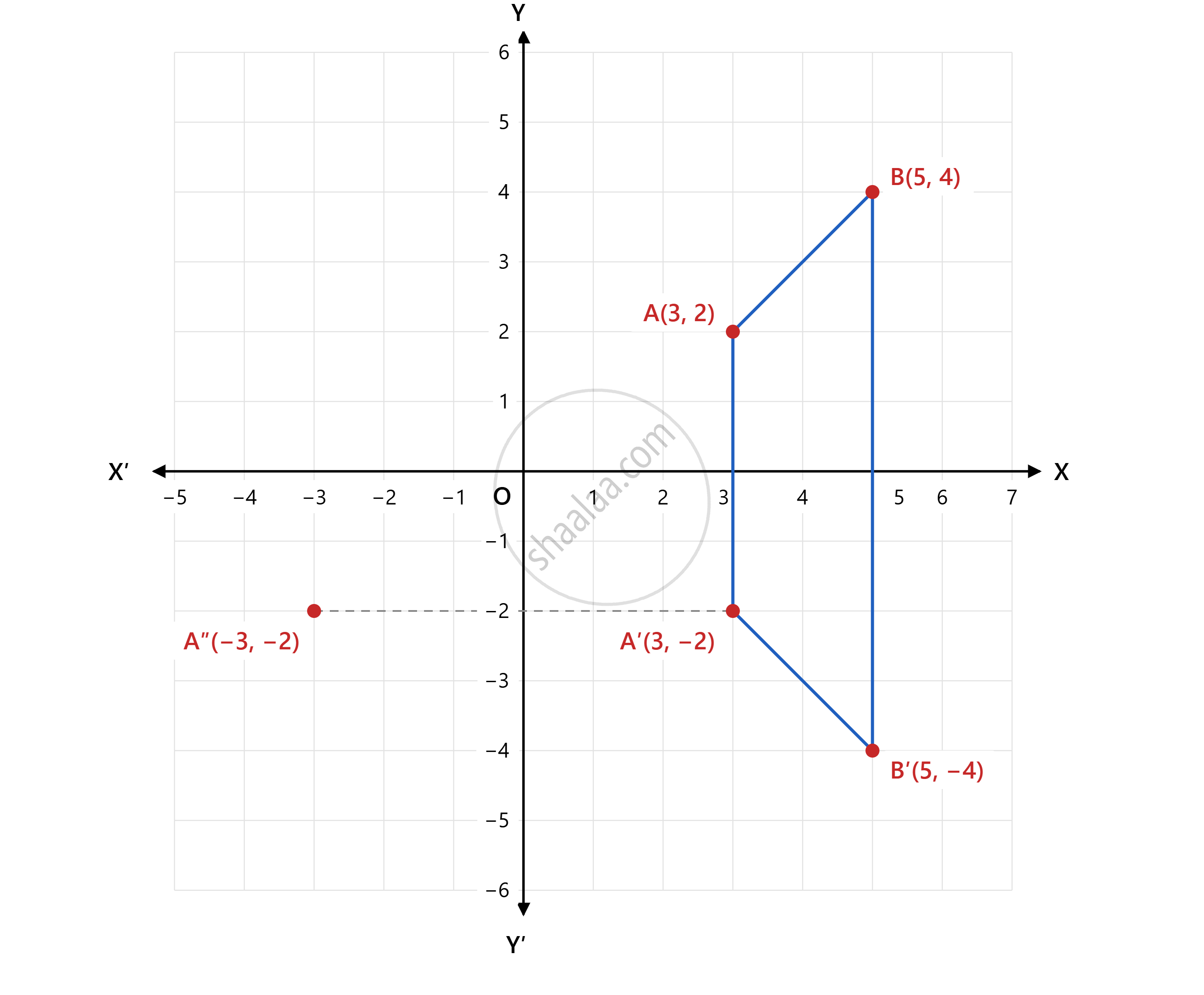
(i) A(3, 2) and B(5, 4) are plotted on the graph above.
(ii) Reflection in the x-axis maps (x, y) to (x, –y), so A′ is (3, –2) and B′ is (5, –4). The hint in the question says `R_y(5, 4) = (-5, 4)`, but that is a typo. B′ comes from reflecting B in the x-axis, so B′ is (5, –4).
(iii) (a) AA′ and BB′ are both vertical, so AA′ || BB′. Also `AB = A′B′ = 2sqrt(2)`. So ABB′A′ is an isosceles trapezium.
(b) m∠ABB′ = 45°. AB has slope `(4 - 2)/(5 - 3) = 1`, so AB makes 45° with the horizontal and also 45° with the vertical side BB′.
(c) Reflection in the origin maps (x, y) to (–x, –y), so A″ is (–3, –2).
(d) A′(3, –2) → A″(–3, –2) changes only the sign of x. So the single transformation is reflection in the y-axis.
