Advertisements
Advertisements
Question

(i) Identify the above diagram.
(ii) Label the guidelines 1-3.
(iii) Name the phenomenon which takes place in the above diagram.
(iv) Define the phenomenon.
(v) What is the importance of the above phenomenon?
Advertisements
Solution
(i) Chloroplast.
(ii) 1. Granum
2. Stroma.
3. Thylakoids.
(iii) Photosynthesis.
(iv) Photosynthesis is the process by which living plant cells, containing chlorophyll, produce food substances (glucose and starch), from carbon dioxide and water, by using light energy. Plants release oxygen as a waste product during photosynthesis.
(v) Photosynthesis is the source of energy food and oxygen.
APPEARS IN
RELATED QUESTIONS
Chlorophyll in a leaf is required for
Name the following:
The kind of plastids found in the mesophyll cells of the leaf.
Name the following:
The part of chloroplast where the dark reaction of photosynthesis takes place.
Which tissues and cells are mainly concerned with photosynthesis?
A well-watered healthy potted plant with variegated leaves was kept in darkness for about 24 hours. It was then set up as shown in the diagram and exposed to light for about 12 hours. At the end of this time, leaf X and leaf Y were tested for starch. Study the diagram and answer the questions that follow:
(i) Why was the plant initially kept in darkness for 24 hours?
(ii) What is the function of the sodium hydroxide solution in the flask?
(iii) Select the correct leaf from the five available choices shown in the diagram as A, B, C, D, and E. Rewrite the correct answer for the filling in the appropriate letter from the questions that follow:
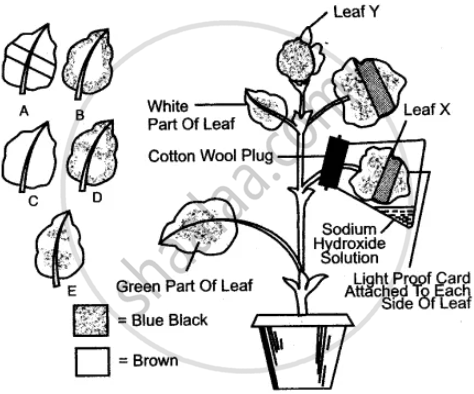
1. After the starch test, leaf X would look like.
2. After the starch test, leaf Y would look like.
Name the following:
The principal site in a green leaf for photosynthesis.
The colour of VIBGYOR spectrum, which is reflected by chlorophyll, is ______.
The granum is a pile of many ______.
Given below are groups of terms. The first pair indicates the relationship between the two terms. Complete the second pair accordingly.
Light reaction : Gran um : : Dark reaction : ______
Distinguish between the following pairs on the basis of the word indicated in the bracket ( ).
Stoma and Stroma (structure)
