Advertisements
Advertisements
Question
How will you prove by an experiment that solids occupy space ?
Advertisements
Solution
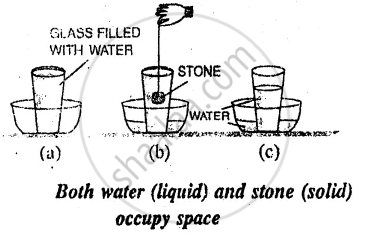
Experiment to show that solids occupy space :
Take a glass bowl. Place a glass tumbler full of water in it. Now tie a stone with thread and lower into the water. Some water flows out of tumbler into bowl. When we remove stone from tumbler the level of water in tumbler comes down. This shows that solids occupy space.
APPEARS IN
RELATED QUESTIONS
What are fluids ? Give two examples.
Write whether the following statement is true or false.
The intermolecular force of attraction is the weakest in gases.
Match the following
| Column A | Column B |
| (a) Solids | (1) Can flow in all directions. |
| (b) Sublimation | (2) The temperature at which a liquid changes into its gaseous state. |
| (c) Boiling point | (3) Any number of free surfaces. |
| (d) Gases | (4) Gaps between particles. |
| (e) Intermolecular space | ro(5) Change of state fm solid to gas. |
Name the phenomenon which cause the following change:
Conversion of water into steam.
Fill in the blank
When a gas is cooled, its molecules ________ energy,
Write whether the following statement are true or false.
The intermolecular force of attraction is the weakest in gases.
Write whether the following statement are true or false.
Intermolecular force of attraction is greater in gases than in liquids.
When a beam of sunlight enters a room through a window, we can see tiny particles X suspended in a gas (or rather a mixture of gases) Y which are moving rapidly in a very haphazard manner.
- What could particles X be ?
- Name the gas (or mixture of gases) Y.
- What is the phenomenon exhibited by particles X known as ?
- What is causing the movement of particles X ?
- What conclusion does the existence of this phenomenon give us about the nature of matter ?
Differentiate the general properties of solids, liquids and gases in the form of a table — with reference to density.
Fill in the blank:
Particles in a gas possess ___________ kinetic energy.
