Advertisements
Advertisements
Question
How will you distinguish between the following pair of terms?
Tetrahedral and octahedral voids
Advertisements
Solution
| Tetrahedral void | Octahedral void | |
| 1. | The tetrahedral void is the name given to the vacant space formed by the touching of four spheres, as shown in the figure.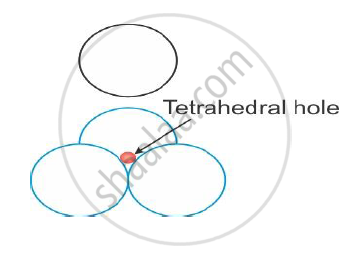 |
Octahedral voids are formed by the combination of voids of two triangular layers of atoms when one triangular layer is placed above another, as shown in the figure.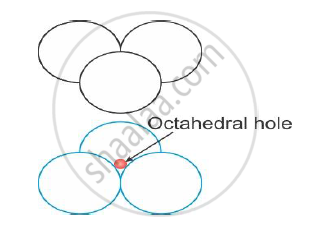 |
| 2. | A tetrahedral void is surrounded by 4 atoms arranged at the corners of a tetrahedron. | An octahedral void is surrounded by 4 atoms arranged at the corners of an octahedron. |
| 3. | Found in close-packed structures like fcc and hcp. | Only present in close-packed structures. |
| 4. | Smaller in size compared to octahedral voids. | Larger in size than tetrahedral voids. |
| 5. | Number of tetrahedral voids = 2 × number of atoms in the lattice | Number of octahedral voids = equal to number of atoms in the lattice |
APPEARS IN
RELATED QUESTIONS
If the radius of the octahedral void is r and the radius of the atoms in close packing is R, derive the relation between r and R.
How many tetrahedral voids can exist per unit cell in a hexagonal close packing sphere?
A compound is formed by two elements A and B. The element B forms cubic close packing and atoms of A occupy `1/3"rd"` of tetrahedral voids. The formula of this compound is ____________.
The Ca2+ and F– are located in CaF2 crystal, respectively at face centered cubic lattice points and in ____________.
Percentages of free space in cubic close packed structure and in the body-centered packed structure are respectively:
If Germanium crystallises in the same way as diamond, then which of the following statement is not correct?
In the cubic close packing, the unit cell has ______.
Which of the following is not true about the voids formed in 3 dimensional hexagonal close packed structure?
(i) A tetrahedral void is formed when a sphere of the second layer is present above triangular void in the first layer.
(ii) All the triangular voids are not covered by the spheres of the second layer.
(iii) Tetrahedral voids are formed when the triangular voids in the second layer lie above the triangular voids in the first layer and the triangular shapes of these voids do not overlap.
(iv) Octahedral voids are formed when the triangular voids in the second layer exactly overlap with similar voids in the first layer.
The number of tetrahedral voids per unit cell in NaCl crystal is:
(i) 4
(ii) 8
(iii) twice the number of octahedral voids.
(iv) four times the number of octahedral voids.
Show that in a cubic close packed structure, eight tetrahedral voids are present per unit cell.
