Advertisements
Advertisements
Question
How will the action of dilute hydrochloric acid enable you to distinguish between sodium carbonate and sodium sulphite?
Advertisements
Solution
Sodium carbonate treated with dil. HCl results in the formation of sodium chloride with the liberation of carbon dioxide gas.
\[\ce{Na2CO3 + 2HCl ⟶ 2NaCl + H2O + CO2 ↑}\]
Sodium sulphite treated with dil. HCl results in the formation of sodium chloride with the liberation of sulphur dioxide gas.
\[\ce{Na2SO3 + 2HCl ⟶ 2NaCl + H2O + SO2 ↑}\]
RELATED QUESTIONS
State your observations when Dilute Hydrochloric acid is added to Copper carbonate
State one relevant observation for the following
When hydrogen sulfide gas is passed through lead acetate solution.
How will the action of dilute hydrochloric acid enable you to distinguish between sodium thiosulphate and sodium sulphite?
State which component is the oxidizing agent in aqua regia.
Write balanced equation for the following reaction:
Copper oxide and dilute hydrochloric acid.
Write the balanced equation for the reaction of dilute hydrochloric acid with the following:
Iron
Write the balanced equation for the reaction of dilute hydrochloric acid with the following:
Sodium hydrogen carbonate
Write an equation for the reactions of hydrochloric acid on manganese (IV) oxide.
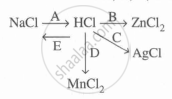
Study the flow chart and give balanced equations with conditions for the conversions A, B, C, D, and E.
State which of the two - a solution of HCl in water or in toluene is an electrolyte. Explain.
