How Does the Friction at the Fulcrum Affect the Mechanical Advantage of the Lever?
Advertisements
Question
How does the friction at the fulcrum affect the mechanical advantage of the lever?
Advertisements
Solution
Friction at the fulcrum reduces the mechanical advantage.
APPEARS IN
RELATED QUESTIONS
Which class of lever has the mechanical advantage always more than 1? Give an example.
Give one example of a class I lever where the mechanical advantage is more than 1.
Name the class to which the following lever belong:
a wheelbarrow
Name the class to which the following levers belong:
a pair of pliers
In a lever, the fulcrum is at one end at a distance of 30 cm from the load and effort is at the other end at a distance of 90 cm from the load. Find :
(a) the length of load arm,
(b) the length of effort arm, and
(c) the mechanical advantage of the lever.
Name the three classes of levers and state how are they distinguished. Give two examples of each class.
Give one example of a class I lever where mechanical advantage is less than 1.
Both a pair of scissors and a pair of pliers belong to the same class of levers. Name the class of lever. Which one has the mechanical advantage less than 1?
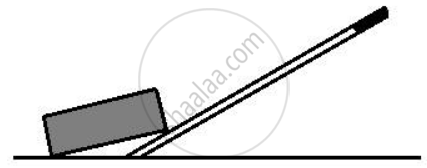
The diagram below shows a rod lifting a stone.
- Mark position of fulcrum F and draw arrows to show the directions of load L and effort E.
- What class of lever is the rod?
- Give one more example of the same class of lever stated in part (b).
Match the following:
| 1. | Class I lever | a. | Wheelbarrow |
| 2. | Class II lever | b. | Seesaw |
| 3. | Class III lever | c. | Axe |
| 4. | Wedge | d. | Hockey sick |
