Advertisements
Advertisements
Question
How does an increase in the price of a commodity affect the quantity demanded? Explain it with the help of a diagram.
Advertisements
Solution
An increase in demand of a commodity results in a rightward shift of the demand curve, which leads to an increase in price.
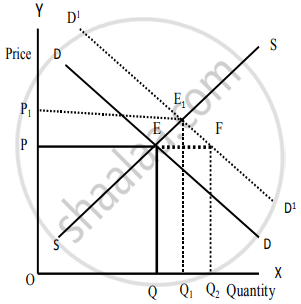
At point E in the diagram, the supply and demand for the good are equal. E is the equilibrium point, then. OQ is the equilibrium quantity at this time, while OP is the equilibrium price. There is EF excess demand at OP price when demand rises and the demand curve moves to the right, or D1 D1. Customers become more competitive as a result, driving up the price. The amount supplied will rise and the quantity wanted will decrease at a higher price, causing the supply and demand curves not to move upward. By doing this, the difference between the quantity delivered and the quantity demanded is lessened. Until we reach the new equilibrium point E1, when quantity provided equals quantity required, these shifts will persist. The new equilibrium price is now OP1. The equilibrium price has increased since the new equilibrium price [OP1] is greater than the previous equilibrium price [OP].
