Advertisements
Advertisements
Question
How do non-metals react with oxygen? Explain with an example. Give equation of the reaction involved. What is the nature of the product formed? How will you demonstrate it?
Advertisements
Solution
Non-metals react with oxygen to form acidic oxides or neutral oxides.
Sulphur is a non-metal. When sulphur is burned in air, it reacts with the oxygen of air to form an acidic oxide called sulphur dioxide:
\[\ce{\underset{(Non-metal)}{\underset{Sulphur}{S_{(s)}}} + \underset{(From air)}{\underset{Oxygen}{O2_{(g)}}} -> \underset{(Acidic oxide)}{\underset{Sulphur dioxide}{SO2_{(g)}}}}\]
The acidic oxide, sulphur dioxide, dissolves in water to form an acid called sulphurous acid.
\[\ce{\underset{(Acidic oxide)}{\underset{Sulphur dioxide}{SO2_{(g)}}} + \underset{Water}{H2O_{(l)}} -> \underset{(An acid)}{\underset{Sulphurous acid}{H2SO3_{(aq)}}}}\]
A solution of sulphur dioxide in water turns blue litmus to red. This shows that sulphur dioxide is acidic in nature.
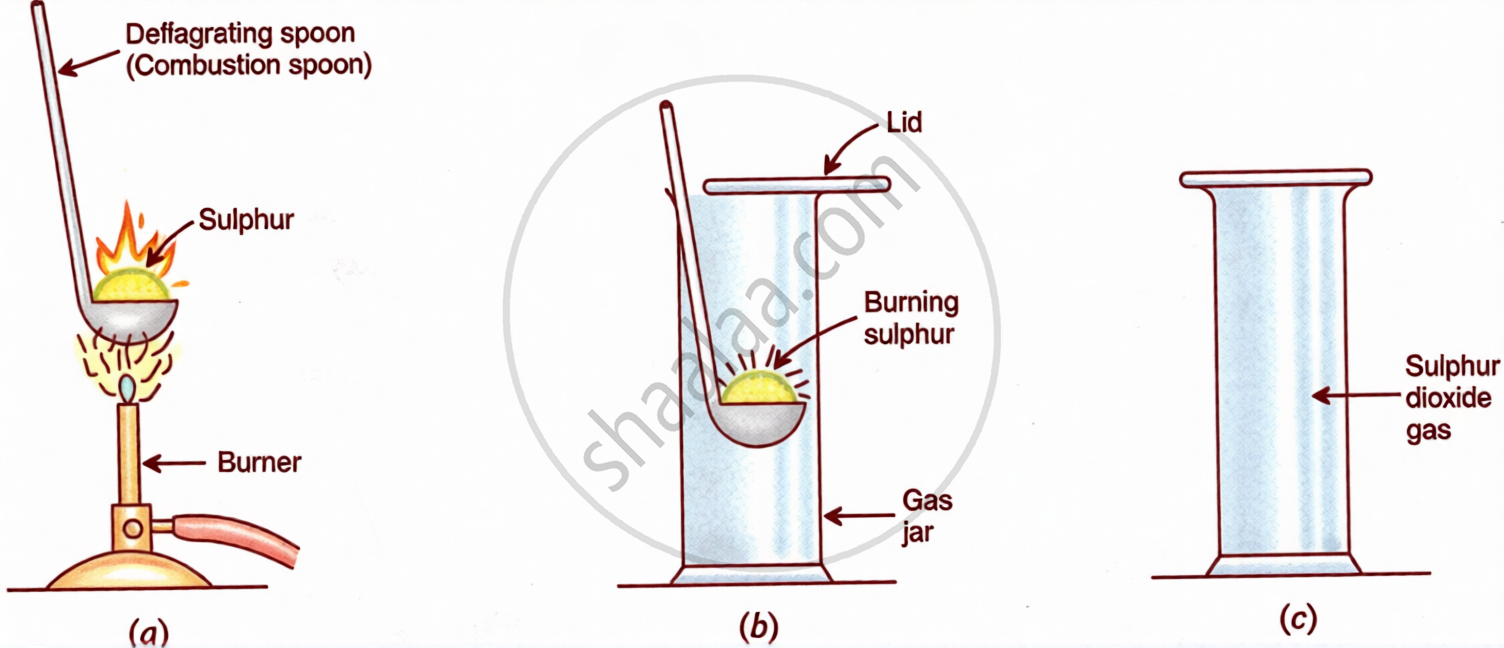
Take a small amount of sulphur powder in a deflagrating spoon (combustion spoon) and heat it over the flame of a burner as shown in the figure (a). After some time, the sulphur will start burning with a blue flame. As soon as sulphur starts burning, we introduce the deflagrating spoon in a gas jar and allow the sulphur to burn inside the gas jar as shown in the figure (b). Sulphur burns in the air of a gas jar to form a pungent-smelling gas, sulphur dioxide. After all the sulphur has burnt, remove the deflagrating spoon from the gas jar and cover it with a lid. The gas jar now contains sulphur dioxide gas as shown in the figure (c).
