Advertisements
Advertisements
Question
How did Einstein react to the bombing of Hiroshima and Nagasaki?
Advertisements
Solution
Einstein was deeply shaken by the disaster in the Hiroshima and Nagasaki. He wrote a public missive to the United. He proposed the formation of a world government to stop the nuclear weapons.
RELATED QUESTIONS
Imagine that you are the poet, William Wordsworth. You continue on your walk, and when you reach home you tell a friend what you saw and felt. Which of the following best describes your experience? (Work in pairs, then have a class discussion.)
|
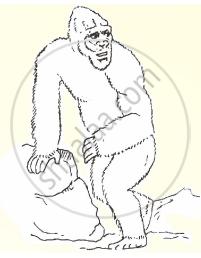
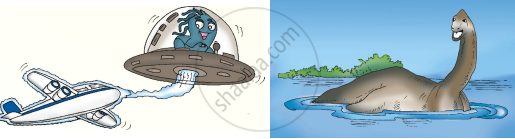
In groups of six, work on one of the mysteries given below by surfing the net and through other sources. Create a power point presentation/a photo essay.
- Yeti, the abominable snowman
- Loch Ness Monster
- UFOs (Unidentified Flying Objects)
- Lost city of Atlantis
- Crop circles
- Nazca lines
Here is a newspaper report of a young girl who went back in time to see how her home town looked seventy years ago.
Dehra Times
|
Purkul, 7 July, 09 It is reported that Kareena, a twelve year old girl living in Purkul, went back in time using a time machine. Seventy years ago her home town was an ideal place to live in. Her home town had not been invaded by the marvels of technology. Industries had not been set up then, so the air was not polluted. She could see children playing in the garden. Some children were listening to the stories told by their grandmothers. Happiness and contentment prevailed everywhere. |
In the newspaper report above, the focus is on the changes as observed by Kareena.
- Kareena’s hometown had not been invaded by the marvels of technology.
- Industries had not been set up.
- The air was not polluted.
- Some children were listening to stories told to them by their grandmothers.
Six humans trapped by happenstance
In black and bitter cold.
Each one possessed a stick of wood,
Or so the story's told.
Their dying fire in need of logs;
The first man held his back.
For on the faces around the fire,
He noticed one was black.
Read the lines given above and answer the question that follow:
What does happenstance mean?
The horse was nearly life-size, moulded out of clay, baked, burnt, and brightly coloured, and reared its head proudly, prancing its forelegs in the air and flourishing its tail in a loop; beside the horse stood a warrior with scythelike mustachios, bulging eyes, and aquiline nose. The old image-makers believed in indicating a man of strength by bulging out his eyes and sharpening his moustache tips, and also decorated the man’s chest with beads which looked today like blobs of mud through the ravages of sun and wind and rain (when it came), but Muni would insist that he had known the beads to sparkle like the nine gems at one time in his life.
Read the extract given below and answer the question that follow.
Had anyone seen the splendour of the horse?
This woman had been despised, scoffed at, and angrily denounced by nearly every man, woman, and child in the village; but now, as the fact of, her death was passed from lip to lip, in subdued tones, pity took the place of anger, and sorrow of denunciation.
Neighbours went hastily to the old tumble-down hut, in which she had secured little more than a place of shelter from summer heats and winter cold: some with grave-clothes for a decent interment of the body; and some with food for the half-starving children, three in number. Of these, John, the oldest, a boy of twelve, was a stout lad, able to earn his living with any farmer. Kate, between ten and eleven, was bright, active girl, out of whom something clever might be made, if in good hands; but poor little Maggie, the youngest, was hopelessly diseased. Two years before a fall from a window had injured her spine, and she had not been able to leave her bed since, except when lifted in the arms of her mother.
“What is to be done with the children?” That was the chief question now. The dead mother would go underground, and be forever beyond all care or concern of the villagers. But the children must not be left to starve.
Read the extract given below and answer the question that follow.
Describe the three children.
After washing from his hands and face the dust and soil of work, Joe left the kitchen, and went to the little bedroom. A pair of large bright eyes looked up at him from the snowy bed; looked at him tenderly, gratefully, pleadingly. How his heart swelled in his bosom! With what a quicker motion came the heart-beats! Joe sat down, and now, for the first time, examining the thin free carefully under the lamp light, saw that it was an attractive face, and full of a childish sweetness which suffering had not been able to obliterate.
“Your name is Maggie?” he said, as he sat down and took her soft little hand in his.
“Yes, sir.” Her voice struck a chord that quivered in a low strain of music.
“Have you been sick long?”
“Yes, sir.” What a sweet patience was in her tone!
“Has the doctor been to see you?”
“He used to come”
“But not lately?”
“No, sir.”
Read the extract given below and answer the questions that follow.
What does Maggie tell Joe?
Most terribly cold it was; it snowed, and was nearly quite dark, and evening— the last evening of the year. In this cold and darkness there went along the street a poor little girl, bareheaded, and with naked feet. When she left home she had slippers on, it is true; but what was the good of that? They were very large slippers, which her mother had hitherto worn; so large were they; and the poor little thing lost them as she scuffled away across the street, because of two carriages that rolled by dreadfully fast.
One slipper was nowhere to be found; the other had been laid hold of by an urchin, and off he ran with it; he thought it would do capitally for a cradle when he some day or other should have children himself. So the little maiden walked on with her tiny naked feet, that were quite red and blue from cold. She carried a quantity of matches in an old apron, and she held a bundle of them in her hand. Nobody had bought anything of her the whole livelong day; no one had given her a single farthing. She crept along trembling with cold and hunger—a very picture of sorrow, the poor little thing!
Read the extract given below and answer the question that follow.
Does the author give us a glimpse into the Victorian society?
From the day, perhaps a hundred years ago when he sun had hatched him in a sandbank, and he had broken his shell, and got his head out and looked around, ready to snap at anything, before he was even fully hatched-from that day, when he had at once made for the water, ready to fend for himself immediately, he had lived by his brainless craft and ferocity. Escaping the birds of prey and the great carnivorous fishes that eat baby crocodiles, he has prospered, catching all the food he needed, and storing it till putrid in holes in the bank. Tepid water to live in and plenty of rotted food grew him to his great length. Now nothing could pierce the inch-?thick armoured hide. Not even rifle bullets,
which would bounce off. Only the eyes and the soft underarms offered a place. He lived well in the river, sunning himself sometimes with other crocodiles-muggers, as well as the long-? snouted fish-?eating gharials-on warm rocks and sandbanks where the sun dried the clay on them quite white, and where they could plop off into the water in a moment if alarmed. The big crocodile fed mostly on fish, but also on deer and monkeys come to drink, perhaps a duck or two.
Read the extract given below and answer the question that follow.
What protected him now? How?
It was the summer of 1936. The Olympic Games were being held in Berlin. Because Adolf Hitler childishly insisted that his performers were members of a “master race,” nationalistic feelings were at an all-time high.
I wasn’t too worried about all this. I’d trained, sweated and disciplined myself for six years, with the Games in mind. While I was going over on the boat, all I could think about was taking home one or two of those gold medals. I had my eyes especially on the running broad jump. A year before, as a sophomore at the Ohio State, I’d set the world’s record of 26 feet 8 1/4 inches. Nearly everyone expected me to win this event.
Read the extract given below and answer the question that follow.
Explain, ‘I wasn’t too worried about all this. I’d trained, sweated disciplined myself for six years with the game in the mind.
What changes occurred in Pamela's persona/ii after the August holiday?
Find in the poem an antonym (a word opposite in meaning) of the following word
grow
How was the bear punished when he attacked a beehive?
What is one thing that dreams can never tell?
“But mother says that kind is good…” What is mother referring to?
Multiple Choice Question:
The word ‘caring’ in the passage means ______
Multiple Choice Question:
When does the kite lose all its energy?
(i) Like Patrick in the story ‘Who Did Patrick’s Homework’, Taro is helped by magic. Do you believe in magic? What are the magical things that happen in these stories?
(ii) Which story do you like better, and why? Do you know such stories in other languages? Discuss these questions in class.
Look at the following picture. One asks a question, the other answers it. Then the answer is noted in a form as shown below.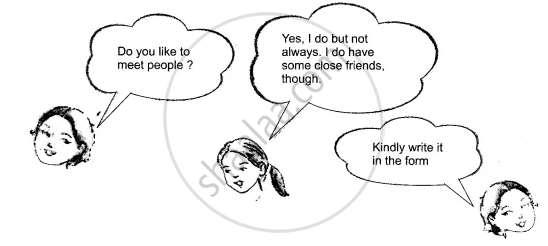
| Questions | Yes/No | Additional Response |
|
1. Do you like to meet people? |
Yes I do, but not always | I do have some close friends, though. |
|
2. Do you like the area you live in? |
No, I Don't | But I have no choice |
Complete the following sentence by providing a reason:
In Act III, Scene II of the play The Tempest, Stephano and Trinculo are angry with Caliban as they struggle out of the filthy pool because ______.
