Advertisements
Advertisements
Question
How can they be made to leave the metal surface? (State any two ways)
Advertisements
Solution
Electron emission from the metal surface can be (any two):
1) Thermionic emission – when energy is supplied as heat
2) Photoelectric emission – when energy is supplied as energy.
3) Field emission – when energy is supplied by applying an electric field to accelerate the electrons.
4) Secondary emission – when energy is supplied from the kinetic energy of other electrons on collisions with them.
APPEARS IN
RELATED QUESTIONS
When does the nucleus of an atom tend to become radioactive?
A radiation X is focused by a particular device on the bulb of a thermometer and mercury in the thermometer shows a rapid increase. Name the radiation X
What happens if the negative potential is changed on a grid?
Radiations given out from a source when subjected to an electric field in a direction perpendicular to their path are shown below in the diagram. The arrows show the path of the radiation A, B and C. Answer the following questions in terms of A, B and C.
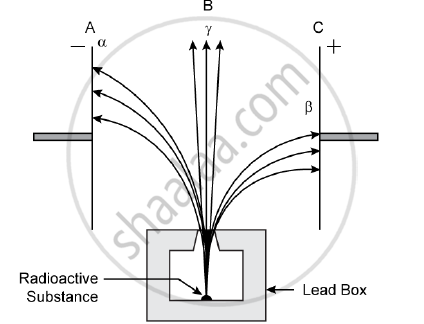
1) Name the radiation B which is unaffected by the electrostatic field.
2) Why does the radiation C deflect more than A?
3) Which among the three causes the least biological damage externally.
4) Name the radiation which is used in carbon dating.
State the penetrating range of α, β and γ radiations.
What happens to the position of an element in the periodic table when it emits an alpha particle
Mention four properties of Becquerel rays.
The half-life of a radioactive nuclide is 100 hours. The fraction of original activity that will remain after 150 hours would be ______.
Why do the nuclei of some atoms undergo radioactive decay?
In the discovery of radioactivity, why could the darkening of the covered photographic plate NOT be explained by ordinary visible light?
