Advertisements
Advertisements
Question
How are polymers classified on the basis of synthesis? Give two examples of each type.
Advertisements
Solution
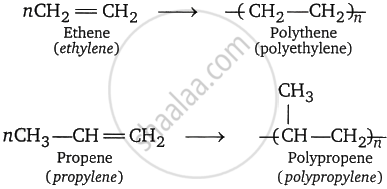
Addition polymerisation and addition polymers: When a large number of monomer molecules add up together to form the polymer chain, the process is called addition polymerisation. The monomers involved in the process are unsaturated molecules, usually derivatives of ethene. This form of polymerisation does not involve the removal of small molecules such as H2O, NH3, or alcohol. Therefore, the repeating unit is identical to the monomer unit. Addition occurs through a chain mechanism involving certain active centres. These reactive centres may be free radicals, carbocations, or carbanions.
The polymers formed by addition polymerisation are called addition polymers. Some examples of addition polymerisation and addition polymers are as follows.
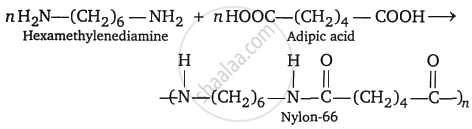
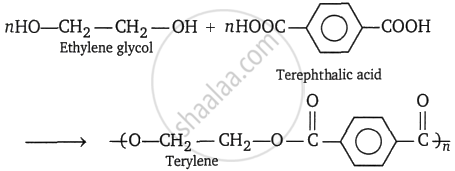
Condensation polymerisation and condensation polymers: Condensation polymerisation involves a sequence of condensation processes. Polymerisation often transpires between monomers possessing two or more functional groups. Each step in this type of polymerisation involves the loss of small molecules such as H2O, NH3, alcohol, etc. Therefore, the repeating unit in a condensation polymer is not the same as the monomer.
The polymers formed by condensation polymerisation are called condensation polymers. Some examples of condensation polymerisation and condensation polymers are as follows.