Advertisements
Advertisements
Question
Here is a rectangle of an area of 20 square cm.
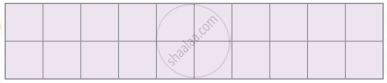
Draw one straight line in this rectangle to divide it into two equal rectangles. What is the area of each of the smaller rectangles?
Advertisements
Solution

A line can be drawn as shown in this figure to divide the given rectangle into two equal rectangles.
Similarly, a horizontal line can also be drawn to divide the given rectangle into two equal rectangles.
Area of each smaller rectangle
= `1/2` × Area of the bigger rectangle
= `1/2 xx 20`
= 10 square cm
RELATED QUESTIONS
If the length and breadth of a rectangle are doubled, how many times the perimeter of the old rectangle will that of the new rectangle be?
If the side of a square is tripled, how many times will its area be as compared to the area of the original square?
The side of a square is 4 cm. The length of a rectangle is 8 cm and its width is 2 cm. Find the perimeter and area of both figures.
What will be the labour cost of laying the floor of an assembly hall that is 16 m long and 12 m wide if the cost of laying 1 sq m is 80 rupees?
The length and breadth of a rectangle are as given below:
9m and 6m
What is the cost of tiling a rectangular plot of land 500 m long and 200 m wide at the rate of ₹ 8 per hundred sq m.?
How many tiles whose length and breadth are 12 cm and 5 cm respectively will be needed to fit in a rectangular region whose length and breadth are:
100 cm and 144 cm
Area of shaded portion in the following figure is ______.

A school playground is divided by a 2 m wide path which is parallel to the width of the playground, and a 3 m wide path which is parallel to the length of the ground (see figure). If the length and width of the playground are 120 m and 80 m respectively, find the area of the remaining playground.

A rectangular field is 48 m long and 12 m wide. How many right triangular flower beds can be laid in this field, if sides including the right angle measure 2 m and 4 m, respectively?
