Advertisements
Advertisements
Question
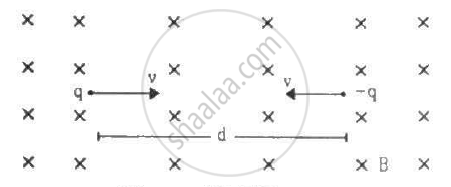
Two particles, each with mass m are placed at a separation d in a uniform magnetic field B, as shown in the figure. They have opposite charges of equal magnitude q. At time t = 0, the particles are projected towards each other, each with a speed v. Suppose the Coulomb force between the charges is switched off. (a) Find the maximum value vmof the projection speed, so that the two particles do not collide. (b) What would be the minimum and maximum separation between the particles if v = vm/2? (c) At what instant will a collision occur between the particles if v = 2vm? (d) Suppose v = 2vm and the collision between the particles is completely inelastic. Describe the motion after the collision.
Advertisements
Solution
Given,
Mass of two particles = m
Distance between them = d
Both the particles have equal charges in magnitude but opposite polarity equal to q.
As per the question, both the particles are projected towards each other with equal speed v.
It is assumed that Coulomb force between the charges is switched off.
(a) The maximum value vm of the projection speed so that the two particles do not collide:-
Both the particles will not collide if
d = r1 + r2 (where, r1 = r2 = radius of circular orbit described by the charged particles)
`⇒ d = (mv_m)/(qB) + (mv_m)/(qB) = (2mv_m)/(qB)`
`so, v_m = (qBd)/(2m)`

(b) The minimum and maximum separation between the particles if v = vm/2:-
Let the radius of the curved path taken by the particles, when they are projected with speed vm/2, be r.
So, minimum separation between the particles = (d - 2r)
`⇒ (d - 2r) = (2mv_m)/(qB) - (2mv)/(qB)`
`⇒ (d - 2r) = (mv_m)/(qB)`
`⇒ (d - 2r) = d/2`
Maximum distance separation = (d + 2r)
`⇒ d + 2r = d + d/2 = (3d)/2`
(c) The instant at which the collision occurs between the particles when
The particles will collide at a distance d/2 along the horizontal direction.
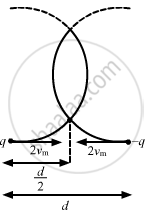
Let they collide after time t.
Velocity of the particles along the horizontal direction will remain the same.
Therefore, `t = d//2/(2v_m)`
`⇒ t = d/4xx(2m)/(qBd)`
(d) The motion of the two particles after collision when the collision is completely inelastic:-
v = 2vm
Let the particles collide at point P.
And at point P, both the particles will have motion in upward direction.
As the collision is inelastic they stick together.
Distance between centres = d
Velocity along the horizontal direction does not get affected due to the magnetic force.
At point P, velocities along the horizontal direction are equal and opposite. So, they cancel each other.
Velocity along the vertical direction (upward) will add up.
Magnetic force acting along the vertical direction,
`F=q(2v_m)B`
Acceleration along the vertical direction,
`a = F/m = (2qv_mB)/m`
Velocity of the combined mass at point P is along the vertical direction. So,
`v'= 0 + a × t`
`v' = 0 + ((2qv_mB)/(m))xx((m)/(2qb))`
`v' = v_m`
Hence, both the particles will behave as a combined mass and move with velocity vm.
APPEARS IN
RELATED QUESTIONS
A moving charged particle q travelling along the positive x-axis enters a uniform magnetic field B.
When will the force acting on q be maximum?
A straight wire of mass 200 g and length 1.5 m carries a current of 2 A. It is suspended in mid air by a uniform magnetic field B. What is the magnitude of the magnetic field?
Write the expression for the force,`vecF` acting on a charged particle of charge ‘q’, moving with a velocity `vecV` in the presence of both electric field `vecF`and magnetic field `vecB` . Obtain the condition under which the particle moves undeflected through the fields.
A charged particle is whirled in a horizontal circle on a frictionless table by attaching it to a string fixed at one point. If a magnetic field is switched on in the vertical direction, the tension in the string
If a charged particle at rest experiences no electromagnetic force,
(a) the electric field must be zero
(b) the magnetic field must be zero
(c) the electric field may or may not be zero
(d) the magnetic field may or may not be zero
A charged particle moves along a circle under the action of possible constant electric and magnetic fields. Which of the following is possible?
(a) E = 0, B = 0
(b) E = 0, B ≠ 0
(c) E ≠ 0, B = 0
(d) E ≠ 0, B ≠ 0
Two particles X and Y having equal charge, after being accelerated through the same potential difference enter a region of uniform magnetic field and describe circular paths of radii R1 and R2 respectively. The ratio of the mass of X to that of Y is ______.
A magnetic field of \[(4.0\times10^-3 \overrightarrow k)\] T exerts a force of \[(4.0 \overrightarrow i + 3.0 \overrightarrow j ) \times 10^{−10} N\] on a particle with a charge of 1.0 × 10⁻⁹ C and going in the x − y plane. Find the velocity of the particle.
When a proton is released from rest in a room, it starts with an initial acceleration a0towards west. When it is projected towards north with a speed v0, it moves with an initial acceleration 3a0 towards west. Find the electric field and the maximum possible magnetic field in the room.
Using the formula \[\vec{F} = q \vec{v} \times \vec{B} \text{ and } B = \frac{\mu_0 i}{2\pi r}\]show that the SI units of the magnetic field B and the permeability constant µ0 may be written as N mA−1 and NA−2 respectively.
Prove that the force acting on a current-carrying wire, joining two fixed points a and b in a uniform magnetic field, is independent of the shape of the wire.
A semicircular wire of radius 5.0 cm carries a current of 5.0 A. A magnetic field B of magnitude 0.50 T exists along the perpendicular to the plane of the wire. Find the magnitude of the magnetic force acting on the wire.
A particle of charge 2.0 × 10⁻⁸ C and mass 2.0 × 10⁻¹⁰ g is projected with a speed of 2.0 × 10³ m s−1 in a region with a uniform magnetic field of 0.10 T. The velocity is perpendicular to the field. Find the radius of the circle formed by the particle and also the time period.
A particle of mass m and positive charge q, moving with a uniform velocity v, enters a magnetic field B, as shown in the figure. (a) Find the radius of the circular arc it describes in the magnetic field. (b) Find the angle subtended by the arc at the centre. (c) How long does the particle stay inside the magnetic field? (d) Solve the three parts of the above problem if the charge q on the particle is negative.

A particle of mass m and charge q is projected into a region that has a perpendicular magnetic field B. Find the angle of deviation (figure) of the particle as it comes out of the magnetic field if the width d of the region is very slightly smaller than
(a) `(mv)/(qB)` (b)`(mv)/(2qB)` (c)`(2mv)/(qB)`
The figure shows a convex lens of focal length 12 cm lying in a uniform magnetic field Bof magnitude 1.2 T parallel to its principal axis. A particle with charge 2.0 × 10⁻³ C and mass 2.0 × 10⁻⁵ kg is projected perpendicular to the plane of the diagram with a speed of 4.8 m s−1. The particle moves along a circle with its centre on the principal axis at a distance of 18 cm from the lens. Show that the image of the particle moves along a circle and find the radius of that circle.

A particle moves in a circle of diameter 1.0 cm under the action of a magnetic field of 0.40 T. An electric field of 200 V m−1 makes the path straight. Find the charge/mass ratio of the particle.
When does a moving charged particle nor experience any force while moving through a uniform magnetic field?
