Advertisements
Advertisements
Question
Heating effect of current is called ______
Options
Joule heating
Coulomb heating
Voltage heating
Ampere heating
Advertisements
Solution
Heating effect of current is called Joule heating.
APPEARS IN
RELATED QUESTIONS
The current passing through a room heater has been halved. What will happen to the heat produced by it?
Heat energy is being produced in a resistance in a circuit at the rate of 100 W. The current of 3 A is flowing in the circuit. What must be the value of the resistance?
What is the heating effect of electric current?
Which metal is used to make the filament of an electric bulb?
When a switch is in OFF position,
- circuit starting from the positive terminal of the cell stops at the switch.
- circuit is open.
- no current flows through it.
- current flows after some time.
Choose the combination of correct answer from the following.
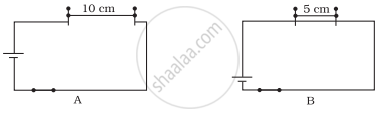
Paheli took a wire of length 10 cm. Boojho took a wire of 5 cm of the same material and thickness. Both of them connected the wires as shown in the circuit given in the following figure. The current flowing in both the circuits is the same.
- Will the heat produced in both cases be equal? Explain.
- Will the heat produced be the same if the wires taken by them are of equal lengths but of different thickness? Explain.
______ wire is used in the filament of the bulbs.
Fuse is a strip of alloy wire which is made up of lead and tin with a very low ______.
The following is not a safety device.
Two students decided to investigate the effect of water and air on iron object under identical experimental conditions. They measured the mass of each object before placing it partially immersed in 10 ml of water. After a few days, the object were removed, dried and their masses were measured. The table shows their results.
| Student | Object | Mass of Object before Rusting in g |
Mass of the coated object in g |
| A | Nail | 3.0 | 3.15 |
| B | Thin plate | 6.0 | 6.33 |
What might be the reason for the varied observations of the two students?
