Advertisements
Advertisements
Question
Glucose is actively reabsorbed in the proximal convoluted tubule.
Options
True
False
Advertisements
Solution
This statement is True.
Explanation:
Glucose is actively reabsorbed in the proximal convoluted tubule of the nephron through specific transport proteins, ensuring that it is almost entirely reclaimed from the filtrate back into the bloodstream.
APPEARS IN
RELATED QUESTIONS
Define the following:
Excretory organs
Tick the most appropriate answer.
A network of capillaries present in the Bowman’s capsule is called
Fill in the blank.
.................. are a pair of reddish-brown, bean-shaped structures that lie on either side of the backbone.
Given alongside is the figure of certain organs and associated parts in the human body. Study the same and answer the questions that follow:
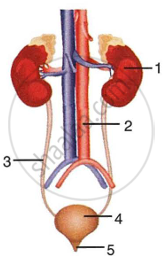 |
- Name all the organ systems shown completely or even 3 partially.
- Name the parts numbered 1 to 5.
- Name the structural and functional unit of the part marked '1'.
- Name the two main organic constituents of the fluid that flows down the part labelled '3'.
- Napie the two major steps involved in the formation of the fluid that passes down the part labelled '3'.
Name the following:
Animals which eliminate urea.
“Kidneys are the master chemist of the body”. Comment.
Write the functional activity of the following structure:
Urethra
Write about the excretory role of the lungs.
Draw a well-labeled diagram of the human excretory system.
Complete the following sentence with appropriate word:
The process of removing the metabolic waste from the body is known as ______.
Mention, if the following statement is True or False. If false rewrite the wrong statement in its correct form:
Urine leaves the urinary bladder of a female by means of the uterus.
Choose the correct option.
Person suffering from kidney stone is advised not to have tomatoes as it has _______.
How many kidneys do we have?
The Malpighian corpuscle lies in the______ of the kidney.
The left side of the heart receives oxygenated blood from ______.
Kidneys receive approximately ______ liters of blood.
The nitrogenous wastes are removed from the body by the endocrine system.
The narrower lower part of the uterus is ______.
Give two examples of the following:
Accessory excretory organs
Write full form of the following abbreviation:
PCT
