Advertisements
Advertisements
Question
Given below is a list or other expressions. Decide what each expression means, by writing D for 'difference' or S for 'similarity' against each. Try to add more expressions to your list and make use of them in writing your article in Question 6.
| Expressions | D or s |
| X is different from Y in that _______ | |
| X and Y are alike in that ______ | |
| X and Y have _____ in common. | |
| Whereas X _________ , Y _____________ | |
| Compared to X, Y ________ | |
| X ____ In contrast, Y ____ | |
| X _____ However, Y _____ | |
| X and Y both |
Advertisements
Solution
| Expressions | D or s |
| X is different from Y in that _______ | D |
| X and Y are alike in that ______ | S |
| X and Y have _____ in common. | S |
| Whereas X _________ , Y _____________ | D |
| Compared to X, Y ________ | D |
| X ____ In contrast, Y ____ | D |
| X _____ However, Y _____ | D |
| X and Y both | S |
APPEARS IN
RELATED QUESTIONS
Here are some direct quotations from the story. Identify the speaker and write what each quotation suggests about the speaker. You can use the adjectives given in the box and may also add your own.
| amiable, tender, gentle, sympathetic, understanding, determined, diligent, kind, concerned, systematic, wise, helpful, enthusiastic, selfish, cruel, humble, religious, prudent |
| Speaker | Quotation | Quality Highlighted | |
|
a. |
'Avva, is everything all right? Are you O.K.?' |
||
| b. | 'At times, I used to regret not going to school, so I made sure that my children and grandchildren studied well.' |
||
| c. | 'Avva, don't cry. What is the matter? Can I help you in anyway?' |
||
| d. | 'We are well-off, but what use is money when I cannot be independent.' | ||
| e. | 'I will keep Saraswati Pooja day during Dassara as the deadline.' | ||
| f. | 'For a good cause if you are determined you can overcome any obstacle.' | ||
| g. | I am touching the feet of a teacher not my granddaughter.' |
Answer the following question briefly:
How was Private Quelch’s knowledge exposed even further as the Sergeant’s classes went on?
Private Quelch knew ‘too much’. Give reasons to prove that he was unable to win the admiration of his superior officers or his colleagues in about 100 words.
Answer the following question:
What was strange about the manner in which Mrs. Bramble addressed her son? What did he feel about it?
Before you read the story write down the answers to these questions.
Which was the latest book that you read?
Who was the author?
Who were the main characters?
When did you read the book?
How long did you take to complete reading it?
What genre did it belong to?
Why would/wouldn't you recommend it?
Answer the following questions:
Why has the word ‘chatter’ been repeated in the poem?
The poem is full of images that come alive through skilful use of words. Describe
any two images that appeal to you the most, quoting the lines from the poem.
List common dilemmas that teenagers face involving the choice of one or more “roads”. Give examples of “roads” that you must travel (e.g. facing peer pressure, choosing friends, observing rules laid down by school and parents, acting on your own values).
On the basis of your understanding of the poem, answer the following question
by ticking the correct choice.
The seven roles that a man plays correspond to his __
On the basis of your understanding of the poem, answer the following question
by ticking the correct choice.
The tone of the narrator is one of ____________.
Answer the following question.
Give an appropriate proverb that conveys the message that this poem carries.
Answer the following question briefly.
Do you like/dislike Gaston? Give reasons.
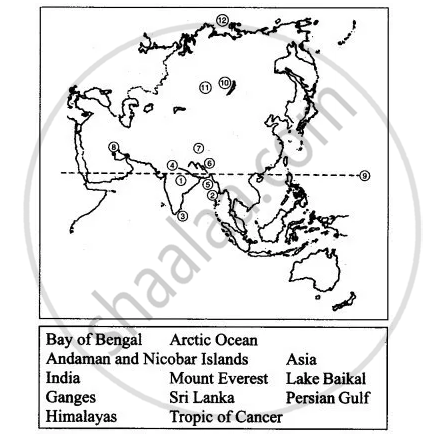
Look at the numbers on the map, and match them with the names given in the box below.
Choose the correct answer and fill in the blanks:
(a) Cars enable you to reach any place you want. ____________ , they pose parking problems in the cities.
(b) I prefer writing __________
(c) He fell ___________ the ladder.
(d) John, as well as his younger brothers, _________ going abroad for further studies.
(e) You’d better take a taxi. ___________ , you’ll arrive late.
(f) It’s not a very good job. _____________ it’s something to start with.
| (a) (i) However (ii) Although (iii) Despite (iv) So that |
(b) (i) on (ii) in (iii) by (iv) with |
| (c) (i) on (ii) out (iii) of (iv) off |
(d) (i) is (ii) are (iii) have (iv) been |
| (e) (i) However (ii) Consequently (iii) Furthermore (iv) Otherwise |
(f) (i) Besides (ii) Moreover (iii) On the other hand (iv) But |
On the basis of the questionnaire, hold a conversation with your partner - one could be a radio jockey and the other could be the pilot.
While you were away on holiday, your house was burgled. Write a letter to
your friend to tell him or her about it.
Use the underlined expressions in Column A above to help you. Include ...
1. how the burglar could have got in,
2. how he knew you had gone away, and
3. what you could have done to prevent the burglary.
On the basis of your reading of the extract, tick mark the most appropriate meaning for the given word :
(i) Infatuated (Para 1}
• fond
• influenced
• disliked
• addicted
(ii) Melancholy (Para 2)
• happy
• sad
• worried
• disappointed
(iii) Petrified (Para 6}
• horrified
• motionless
• stunned
• anxious
(iv) Gravity (Para 7}
• mischievous
• seriousness
• joyfulness
• greatness
Prevention is better than cure.
Swine flu has been declared (as) a pandemic.
In groups of four discuss the following.
(a) What has been done by the authorities to cope with the problem?
(b) What are the consequences of such a major world-wide infection?
Write out the answer to the questions as a flowchart using the passive form of the verb.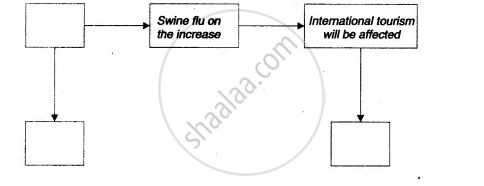
Given alongside are the pictures of two boys - Shravan Kumar and Narendra Kumar. (They are not related.) Working with a partner, look at their pictures and predict how each boys lives. Write your answer in points .

| Shravan Kumar | Narendra Kumar |
When both students have completed their half of the table above, exchange information, by asking and answering questions e.g.
1. What's the weight of the football?
2. When do you get a penalty in hockey?
As you receive information from your partner, write it down in the other half of the table above. (Do not let your partner look at your table!)
