Advertisements
Advertisements
Question
Given below is a set of five parts. Rewrite them in correct sequence.
Cochlea, tympanum, auditory canal, ear ossicles, oval window.
Advertisements
Solution
Auditory canal → tympanum → ear ossicles → oval window → cochlea.
APPEARS IN
RELATED QUESTIONS
Explain the following:
Mechanism through which a sound produces a nerve impulse in the inner ear.
Given below is a diagram depicting a defect of the human eye, study the same and then answer the questions that follow:
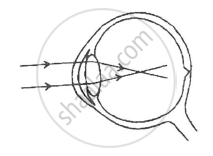
(i) Name the defect shown in the diagram.
(ii) What are the two possible that cause this defect?
(iii) Name the type of lens used to correct this defect.
(iv) With the help of a diagram show how the defect shown above is rectified using a suitable lens.
- Draw a well-labelled diagram of the membranous labyrinth found in the inner ear.
- Based on the diagram drawn above in (i), give a suitable term for each of the following descriptions:
- The sensory cells that help in hearing.
- The part that is responsible for static balance of the body.
- The membrane-covered opening that connects the middle ear to the inner ear.
- The fluid present in the middle chamber of cochlea.
- The structure that maintains dynamic equilibrium of the body.
Give scientific reasons: We cannot distinguish colours in moonlight.
Name the following:
The part which equalises the air pressure in the middle and external ear.
Name the following:
The ear ossicle attached to the tympanum.
There are three small bones in the muddle ear – anvil, hammer and stirrup :
(a) Which of these bones is in touch with ear-drum ?
(b) Which of these bones is in touch with oval window ?
Choose the correct answer.
Canal joining middle ear to pharynx ___________
With reference to human ear answer the question that follow:
Name the part of the ear associated with dynamic balance.
With reference to human ear answer the question that follow:
Name the part of the ear associated with the amplification of vibrations.
